Background
MiniMax released MiniMax-M2.7 in March 2026[2]. Alongside the release, a model card for it appeared on Hugging Face, the site where many AI labs post documentation for their models[1]. That model card is the main public description of the release: it gives the size of the model, the benchmarks the company chose to report, and a pointer to a paper.
What the model card says
The model card lists 229B total parameters[1]. Parameters are the numerical weights a neural network learns during training; the count is a rough measure of how large a model is, and on its own says little about how good it is. The card also cites arXiv 2605.26494 as the paper describing the model[1], so the release came with a technical write-up as well as a model card.
"Deeply participating in its own evolution"
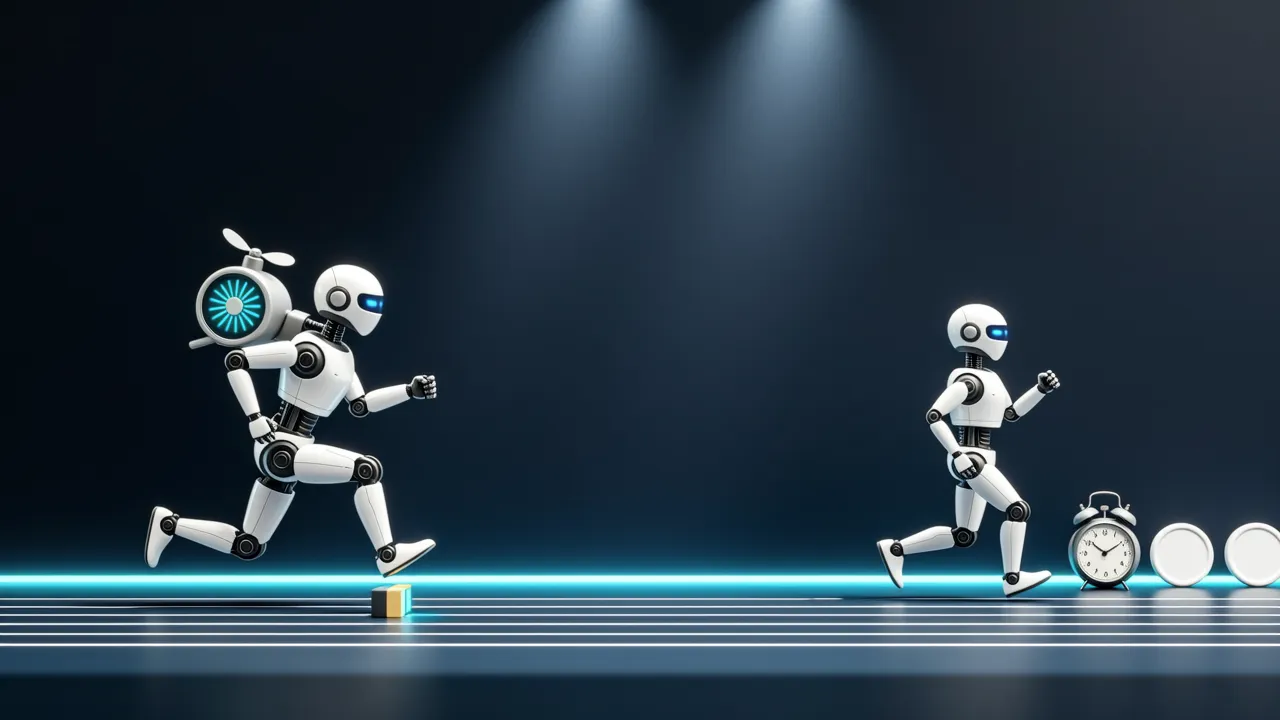
MiniMax described MiniMax-M2.7 as "our first model deeply participating in its own evolution"[1]. The concrete example the company gave was an internal version of the model that autonomously optimized a programming scaffold over more than 100 rounds, reporting a 30% performance improvement[1].
A scaffold is the code wrapped around a model that lets it act: calling tools, editing files, running tests and reading the results back. Optimizing a scaffold means changing that surrounding code, trying the result, and keeping the changes that help. The claim is notable because this loop is usually run by human engineers. Here the company says the model ran the loop itself, and it says so about an internal version rather than the model that was released[1].
Benchmark results
MLE Bench Lite, a set of 22 machine-learning competitions, carried the headline result: the model reached a 66.6% medal rate, which MiniMax said was second only to Opus-4.6 and GPT-5.4[1]. A medal rate of 66.6% means that the submissions earned medals in roughly two-thirds of the competitions.
The model card reported further scores: SWE-Pro 56.22%, Terminal Bench 2 57.0%, SWE Multilingual 76.5, GPQA Diamond 89.8 and AIME 2026 94.2[1]. These benchmarks cover software engineering, command-line work, science questions and competition mathematics, and they are not scored in the same way as one another, so the numbers should not be read across rows as a single ranking.
How to read the release
Two things stand out. First, the comparison MiniMax chose — second only to Opus-4.6 and GPT-5.4[1] — puts the model against strong contemporary systems rather than against the company's own earlier versions. Second, the self-optimization result is a different kind of claim from a benchmark score. It is not only that the model answers questions well, but that it can be put to work improving the machinery around itself. That is a claim about process, and the evidence offered is an internal experiment reported by the company, which an outside reader cannot check from the model card alone[1].
All of the performance figures above come from MiniMax's own reporting[1]. Independent evaluation of the released model is a separate question, and the model card itself is the place where the company's numbers and the paper describing the model sit side by side[1].
Sources
- 1MiniMaxAI/MiniMax-M2.7Hugging Face
- 2MiniMax (company)Wikipedia
Cite this page: MiniMax releases self-improving MiniMax-M2.7. TellWorld, https://www.tellworld.net/news/minimax-m2-7-2026. Updated 2026-11-08