Background
Artificial neural networks are computing systems loosely inspired by the brain. They consist of layers of simple units linked by weighted connections, and training adjusts those weights so the network's outputs improve. For a long time they were one approach among many in artificial intelligence.
The work recognised this year drew on physics. In particular, it used tools from statistical physics, the field that studies how systems made of many interacting parts behave as a whole.
What happened
On 8 October 2024 the Royal Swedish Academy of Sciences awarded the Nobel Prize in Physics 2024 to John J. Hopfield of Princeton University and Geoffrey Hinton of the University of Toronto.[1] The citation reads "for foundational discoveries and inventions that enable machine learning with artificial neural networks."[1]
The Academy said both laureates had worked with artificial neural networks from the 1980s onward, laying the foundation of today's powerful machine learning.[1]
Key details
Hopfield created an associative memory, the Hopfield network, which can store and reconstruct images and other patterns. An associative memory recovers a whole pattern from a partial or noisy cue, much as hearing a few notes can bring back a whole song. The Hopfield network used physics that describes a material's atomic spin, the tiny magnetic orientation of atoms, to define how the network settles into stored patterns.[1]
Hinton built on this work. He used the Hopfield network as the foundation for the Boltzmann machine, which uses tools from statistical physics to learn to recognise characteristic elements in data.[1]
The prize amount was 11 million Swedish kronor, shared equally between the two laureates.[1]
Hinton was born in 1947 in London and received his PhD in 1978 from the University of Edinburgh. Hopfield was born in 1933 in Chicago.[1]
The citation names foundational discoveries and inventions rather than any single later application. The earlier models were simple by today's standards, but they showed in principle how a network could store patterns and learn regularities from data, and that is the sense in which the work is called foundational.
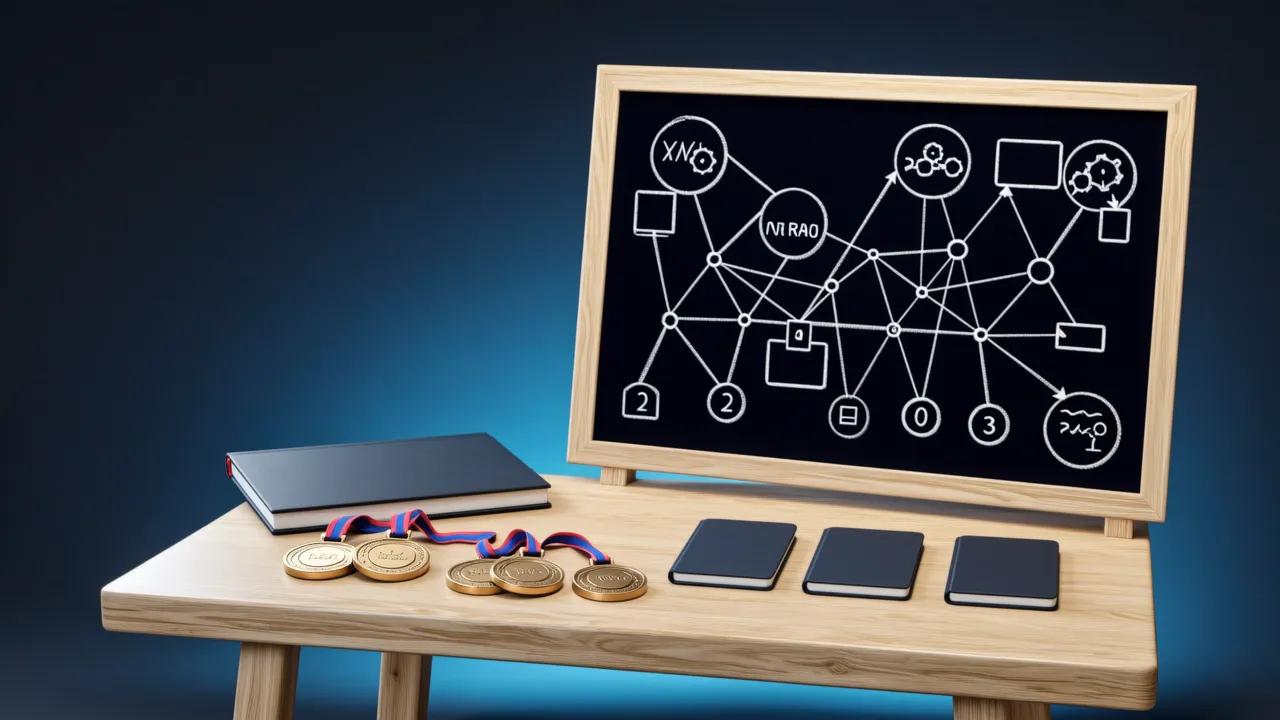
Both models are simple enough to describe on a whiteboard, which is part of why they remain useful for teaching. The award also shows how ideas moved between fields, from physics into the study of computing and learning.
Impact
The award placed the early foundations of neural networks within the framework of physics recognition, and it reminded readers that today's machine learning rests on decades of earlier research. The Academy's word "foundational" points to exactly those early models and methods.
For a general reader, the two ideas make a useful pair. The Hopfield network shows how a memory can be stored as a stable state of a network, while the Boltzmann machine shows how a network can learn regularities from data. Both lines of thought are part of the history that led to later deep learning.
Sources
- 1Press release: The Nobel Prize in Physics 2024Royal Swedish Academy of Sciences
Cite this page: Hopfield and Hinton win the Nobel Prize in Physics for neural-network foundations. TellWorld, https://www.tellworld.net/news/nobel-physics-2024. Updated 2026-11-07