Background
Proteins are long chains of smaller molecules called amino acids, and each chain folds into a specific three-dimensional shape. That shape largely determines what a protein does inside a cell, so knowing it helps researchers study disease and design drugs. Measuring a protein's structure in the laboratory is slow and costly, so for many proteins the sequence of amino acids was known long before the shape was. Because a protein's shape is so closely tied to its job, a hard-to-find shape can slow an entire line of research.
Predicting a protein's three-dimensional structure from its amino acid sequence became one of the long-standing problems of biology. The Royal Swedish Academy of Sciences described it as a 50-year-old problem.[1] Demis Hassabis, the chief executive of Google DeepMind, and John Jumper, a senior research scientist at the same London-based lab, worked on it with artificial intelligence.[1]
What happened
On 9 October 2024 the Academy announced the Nobel Prize in Chemistry and divided it into two parts. Half went to David Baker of the University of Washington and the Howard Hughes Medical Institute 'for computational protein design'. The other half went jointly to Hassabis and Jumper 'for protein structure prediction'.[1] The prize amount was 11 million Swedish kronor.[1]
Key details
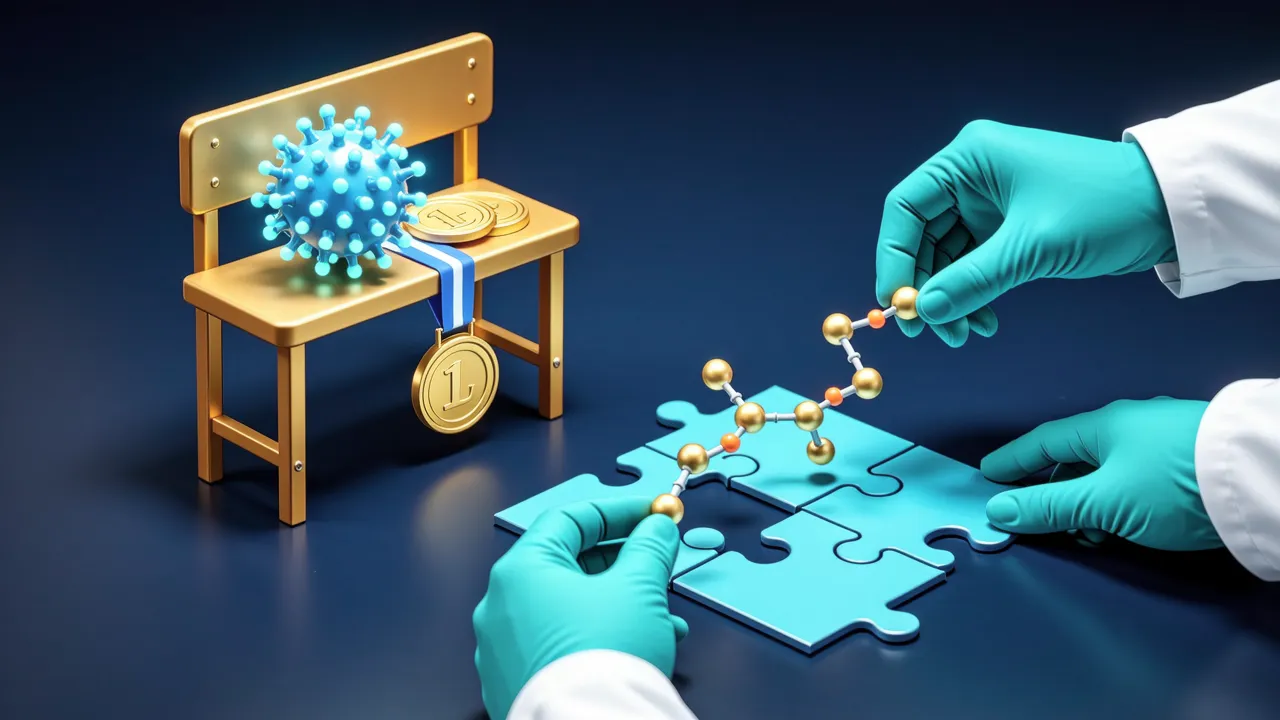
The AI model the Academy credited to Hassabis and Jumper is AlphaFold2, which they presented in 2020. Put simply, it takes a protein's amino acid sequence as input and predicts the shape the chain will fold into.[1] According to the Academy, AlphaFold2 has been used to predict the structure of virtually all of the 200 million proteins that researchers have identified. A scientist can now look up a predicted structure rather than determine each one from scratch.[1]
The Academy also said that more than two million people from 190 countries had used AlphaFold2. Applications it cited include research into antibiotic resistance and imaging enzymes that can decompose plastic.[1]
Baker's work ran in the opposite direction. Rather than reading the shapes of existing proteins, his group has built entirely new kinds of proteins, starting in 2003.[1] Computational protein design uses software to propose amino acid sequences that will fold into a target shape or carry out a chosen function.
Impact
The Academy presented the two halves of the prize as a pair. One recognised work on understanding the structures of natural proteins; the other recognised work on creating new ones.[1] The award placed an AI model at the centre of work honoured in chemistry, a field in which the three-dimensional shape of molecules has long been central.
The clearest near-term effect has been reach. More than two million people in 190 countries used AlphaFold2, so predicted structures have entered many research workflows.[1] Predictions are computed models, however, and laboratory experiments remain the way scientists confirm a structure. The prize recognised a method and its results; it did not make experimental work unnecessary.
Sources
- 1Press release: The Nobel Prize in Chemistry 2024NobelPrize.org
Cite this page: Hassabis and Jumper share the Nobel Prize in Chemistry for AlphaFold. TellWorld, https://www.tellworld.net/news/nobel-chemistry-2024. Updated 2026-11-07