Background
Training and serving large AI models takes a great deal of computing hardware. Large numbers of GPUs sit in data centres, running continuously and drawing electricity that has to be delivered, cooled and networked. Buildings of that kind need land, power and time to construct, so the companies that depend on them increasingly plan capacity years ahead. The Stargate Project was announced as a long-term effort to build infrastructure of this kind.
The announcement
On 21 January 2025, President Donald Trump announced the Stargate Project at a White House press conference, calling it "the largest AI infrastructure project in history"[1][4].
The company behind it, Stargate LLC, was founded by Sam Altman, Larry Ellison and Masayoshi Son, with Son as chairman. It was set up as a joint venture of OpenAI, SoftBank, Oracle and MGX[1][2].
Money: commitment and goal
At the announcement the plan was described as an initial $100 billion, and up to $500 billion by 2029[1][4]. The two figures are not the same kind of number: the $100 billion was a starting commitment, while the $500 billion was a goal over four years rather than a committed sum[4].
Who does what
Altman said SoftBank would have "financial responsibility" and OpenAI "operational responsibility". Arm, Microsoft, Nvidia, Oracle and OpenAI were named as key technology partners[1][4]. The split is a way of separating the money side of the venture from the side that builds and runs systems.
Sites and scale
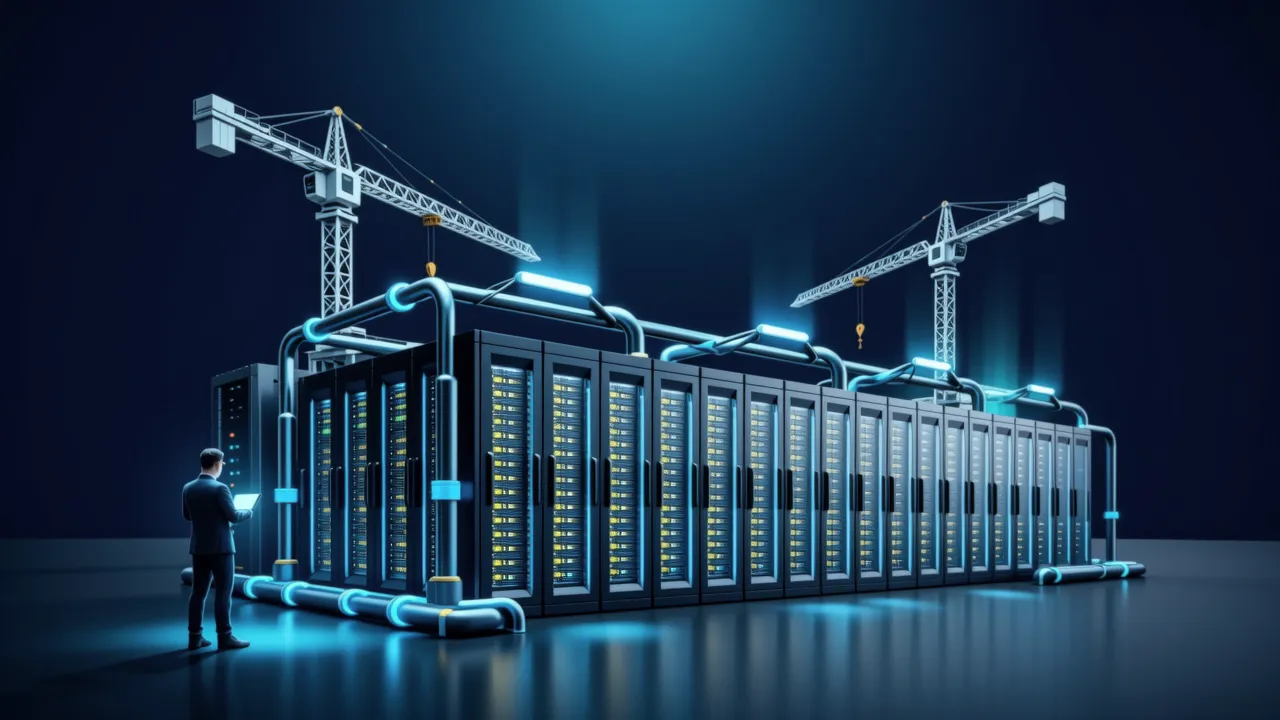
Larry Ellison said 10 data centres were being built in Abilene, Texas[1][4]. Each of the 10 data centres under construction in Texas was about half a million square feet[4], and Ellison expected the number of Texas data centres under construction to grow from 10 to 20[4].
Expansion
On 23 September 2025, OpenAI announced five new sites, bringing planned capacity to nearly 7 gigawatts and over $400 billion of investment[1]. A gigawatt is a unit of power, equal to one billion watts; describing a data centre build-out in gigawatts means describing how much electricity it is meant to be able to draw, which is often the binding constraint for facilities of this size.
What the capacity is for
OpenAI said GPT-6 Astra (September 2026) was its first model pre-trained on more than 100,000 GPUs, at its Stargate site in Texas[3]. Pre-training is the stage in which a model learns from very large bodies of general data before any later tuning; it is usually the most compute-hungry part of building a model, which is why training runs of that size generally need clusters built for the purpose.
How to read the numbers
The announcement bundled three things into a single venture: money, construction and computing contracts. It also set out two different ways of counting size. The January figures were a starting commitment and a four-year goal[1][4], while later reporting added up sites, capacity in gigawatts and total investment[1]. Reading the project means keeping those measures apart: a target is not a signed commitment, and planned capacity is not the same as capacity already running. What the announcements do show is that AI computing has become something described in gigawatts, square feet and hundreds of billions of dollars, and that the companies involved update the picture as sites are added[1].
Sources
- 1Stargate LLCWikipedia
- 2OpenAIWikipedia
- 3GPT-6Wikipedia
- 4
Cite this page: OpenAI, SoftBank and Oracle announce the Stargate Project. TellWorld, https://www.tellworld.net/news/stargate-2025. Updated 2026-11-08