What Amazon means by an agent
Amazon's release came with an explicit definition. The company said it thinks of agents as systems that complete tasks and act in digital and physical environments on the user's behalf, rather than as assistants that only answer in natural language [1]. The distinction shapes how such a system is built. An assistant produces text; an agent produces changes in some other program or interface — a filled-in field, a chosen date, a dismissed dialog box — and has to keep going until the task is done or it fails.
That is difficult because most software on the web was designed for a person looking at a screen. Buttons move, menus open and close, and pop-ups appear at inconvenient moments. A script written in advance breaks the first time a page changes; a model driving the browser has to decide, step by step, what to click.
What was announced
Amazon announced Nova Act on 31 March 2025 [1]. It shipped as a research preview for developers rather than as a general release [1]. A research preview generally means the software is offered to a limited group of developers, with the understanding that its behaviour and interfaces will still change — a way to let people build against a system before it is finished and to gather feedback from real use.
How it works
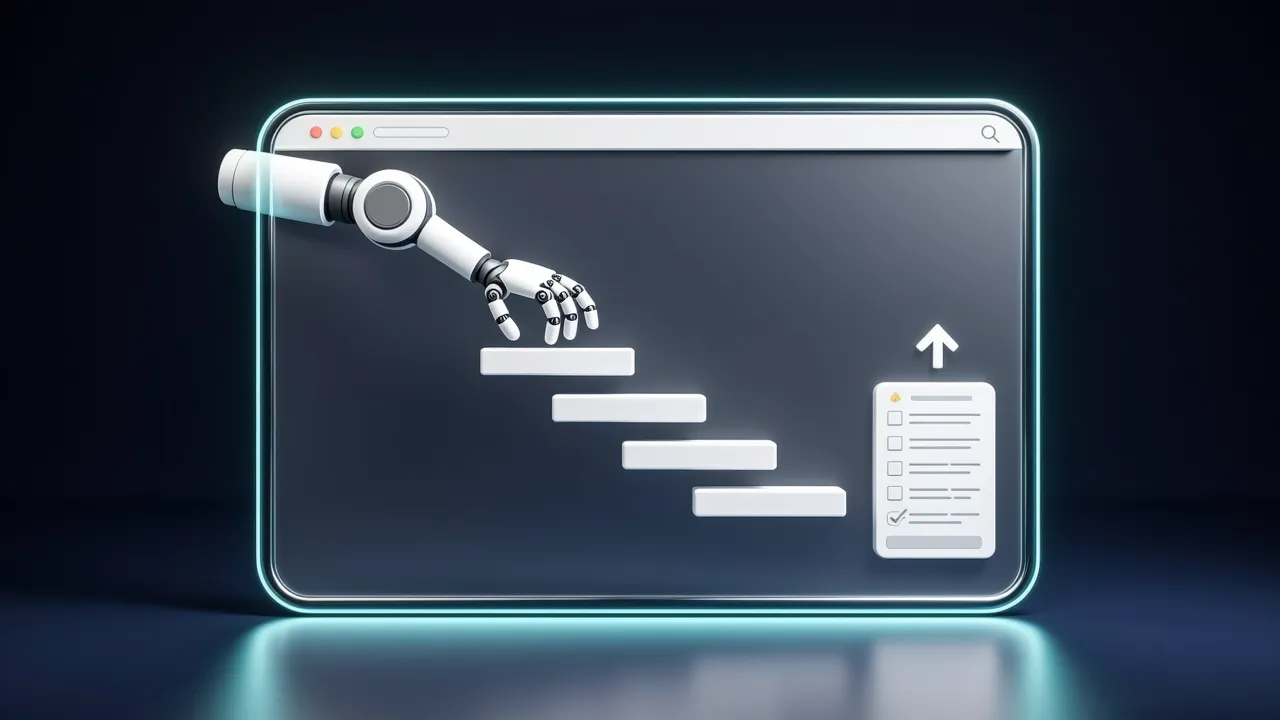
The design choice was to break workflows into atomic, testable commands that developers can interleave with Python code [1]. Atomic here means each command does one small thing — pick a date, choose an item from a drop-down, close a pop-up — so that its success or failure can be checked on its own rather than buried inside one long, opaque run. Interleaving means the surrounding program is ordinary code: loops, conditionals, data handling and logging written in Python, with the model-driven steps inserted only where the page is too irregular for a fixed script.
This is a middle path between two extremes. A fully scripted program is fast and predictable but brittle; a single instruction like "book this" handed to a model is flexible but hard to debug. Splitting the work into verifiable steps lets a developer see exactly which step failed and write ordinary code around it.
Reported results
Amazon reported above 90% on internal evaluations of capabilities such as date picking, drop-downs and pop-ups [1]. These are the small interaction patterns that most often defeat automated browsing, and they are what the atomic command design is aimed at. The figure came from Amazon's own evaluations rather than from an independent benchmark, so it describes performance as the company measured it.
First public use
Its first public use was inside Alexa+, where it navigates the internet when a service lacks the APIs needed [1]. An API (application programming interface) is the channel a service offers for other software to talk to it directly; when a service has none, the only route in is the same web page a person would use, reached through a browser. That case — no direct channel, only a human-facing interface — is the situation agent software exists to handle.
Where it sits
Amazon described the release as an early checkpoint from a larger training curriculum it is pursuing with reinforcement learning [1]. Reinforcement learning, in general terms, improves a system by rewarding behaviour that works and penalising behaviour that does not, over many attempts; calling this an early checkpoint signals that the company expects later versions trained further along the same process.
The product page later described the service as running fleets of agents at scale on AWS infrastructure, with Bedrock AgentCore deployment [2]. That framing moves the subject from a developer tool to infrastructure: many agents running at once, deployed through Amazon's cloud agent platform. Read together, the two descriptions place Nova Act on a line that starts with a research preview for individual developers and ends with agent workloads hosted in the cloud.
Sources
- 1Introducing Amazon Nova ActAmazon Science
- 2Amazon Nova ActAmazon Web Services
Cite this page: Amazon launches Nova Act. TellWorld, https://www.tellworld.net/news/amazon-nova-act-2025. Updated 2026-11-08