Background
Baidu says it began developing autonomous driving in 2013 [1]. By the time Apollo was announced, that internal work had been going on for several years. Driving a car without a person at the wheel requires a whole chain of components: sensors that see the road, computing hardware that runs the software, maps detailed enough to place the car in a lane, and algorithms that decide where to go and how to steer. Assembling the entire chain is expensive, which is why an open platform — a shared base that many partners can build on — is one way to spread the cost.
The launch
On 19 April 2017, at the Shanghai Auto Show, Baidu president and COO Lu Qi announced Apollo [2]. Baidu describes Apollo as "the world's first open platform for autonomous driving" [1]. The pitch was not a finished car but a base that other companies, and outside developers, could work from.
What partners were offered
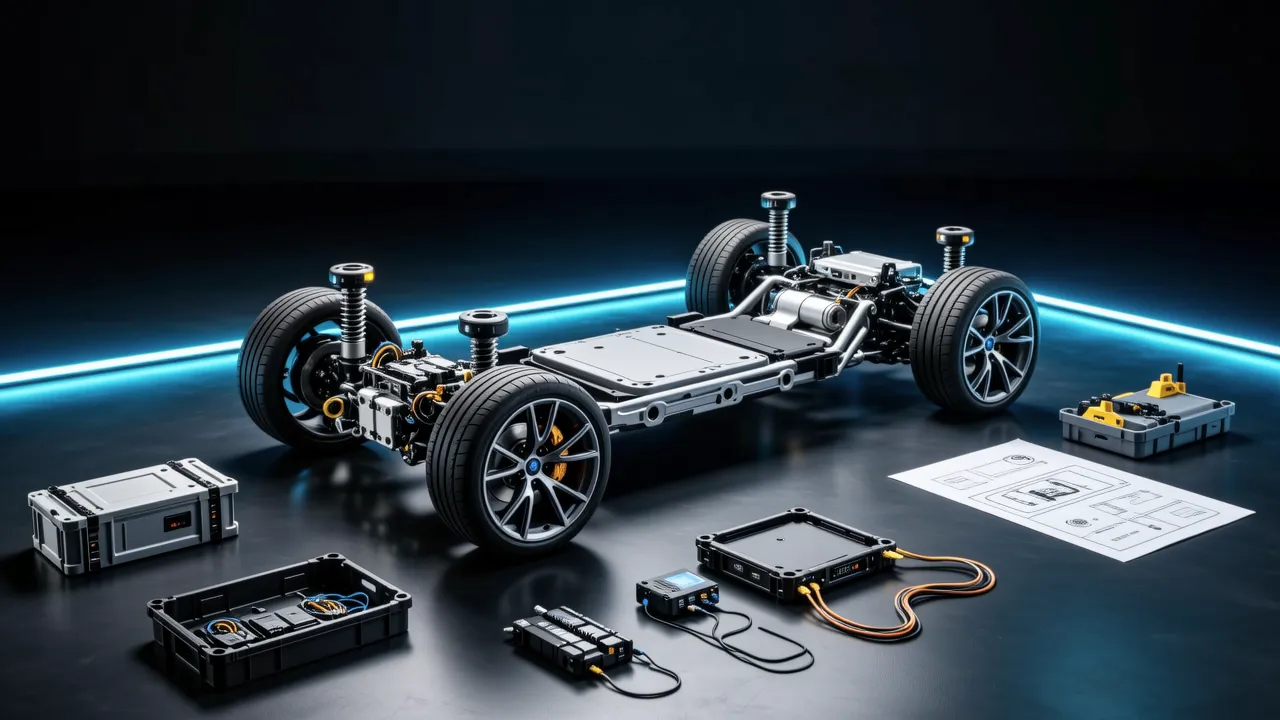
According to Shanghai Securities News, Apollo gave partners a complete software and hardware solution made up of four parts: a vehicle platform, a hardware platform, a software platform and cloud data services [3]. The newspaper reported that Baidu wanted Apollo to become the "Android of the automotive world" [3] — a common base used by many carmakers and suppliers, each building its own variations on top, rather than a single company's product.
An analyst report quoted by China.com.cn said Baidu planned to open source its autonomous driving algorithms to ecosystem participants in July 2017, covering machine vision, route planning, control systems and high-definition maps [4]. Those four items correspond to the basic jobs of a self-driving system: machine vision reads camera images to find lane markings, other vehicles and pedestrians; route planning decides where the car should go; the control system turns that plan into steering, acceleration and braking; and a high-definition map supplies road information finer than an ordinary navigation map. Open source means the code is published so that partners can inspect and modify it instead of writing everything again themselves.
The first months
By November 2017, according to Shanghai Securities News, more than 6,000 developers had supported Apollo on GitHub, more than 1,700 partners had used its open-source code, and more than 100 partners had applied for open data [3]. In September 2017 Baidu upgraded Apollo and said it planned to invest 10 billion yuan over three years in more than 100 autonomous-driving-related projects [3].
A national role
People's Daily Online reported that in November 2017 the Ministry of Science and Technology announced Baidu would lead construction of a national autonomous driving AI platform [2]. That gave Apollo a part to play beyond a single company's open-source project, as a piece of shared technical infrastructure.
Why it matters
Baidu's Apollo site says that as of 7 February 2025 the programme had amassed more than 5,500 autonomous driving patent families [1].
What a platform like this changes is who can take part. If perception, mapping and control have to be rebuilt by every team, progress is slow and expensive; with shared code and data, partners can put their effort into the parts they care about. How far a platform really opens up, and how many partners stay with it, is usually judged by numbers such as how many developers contribute, how many use the code and how many ask for the data — and the figures reported above are exactly that kind of measure.
Sources
- 1
- 2
- 3发布首款人工智能硬件 百度开启「AI家庭机器人」时代上海证券报·中国证券网
- 4Baidu Inc: Launches Apollo Project to reach the next frontier in self-driving cars中国网财经 (analyst report)
Cite this page: Baidu launches the Apollo open autonomous driving platform. TellWorld, https://www.tellworld.net/news/baidu-apollo-2017. Updated 2026-11-08