Background
Most large language models reach users as a hosted service: the model runs on the provider's servers and users send requests over an API. An open-weight release is different — the trained parameters themselves are published, so that others can download them, run them on their own hardware, and modify them. The distinction matters most for reasoning models, which generate intermediate steps before producing a final answer, because those extra steps make inference more expensive and tend to push such systems behind paid interfaces.
What was released
On 5 August 2025, OpenAI released gpt-oss-120b and gpt-oss-20b, a pair of open-weight reasoning models [1]. The weights were published on Hugging Face under the Apache 2.0 license [1][2], a permissive license that allows others to use, modify and redistribute the work.
Sizes and hardware
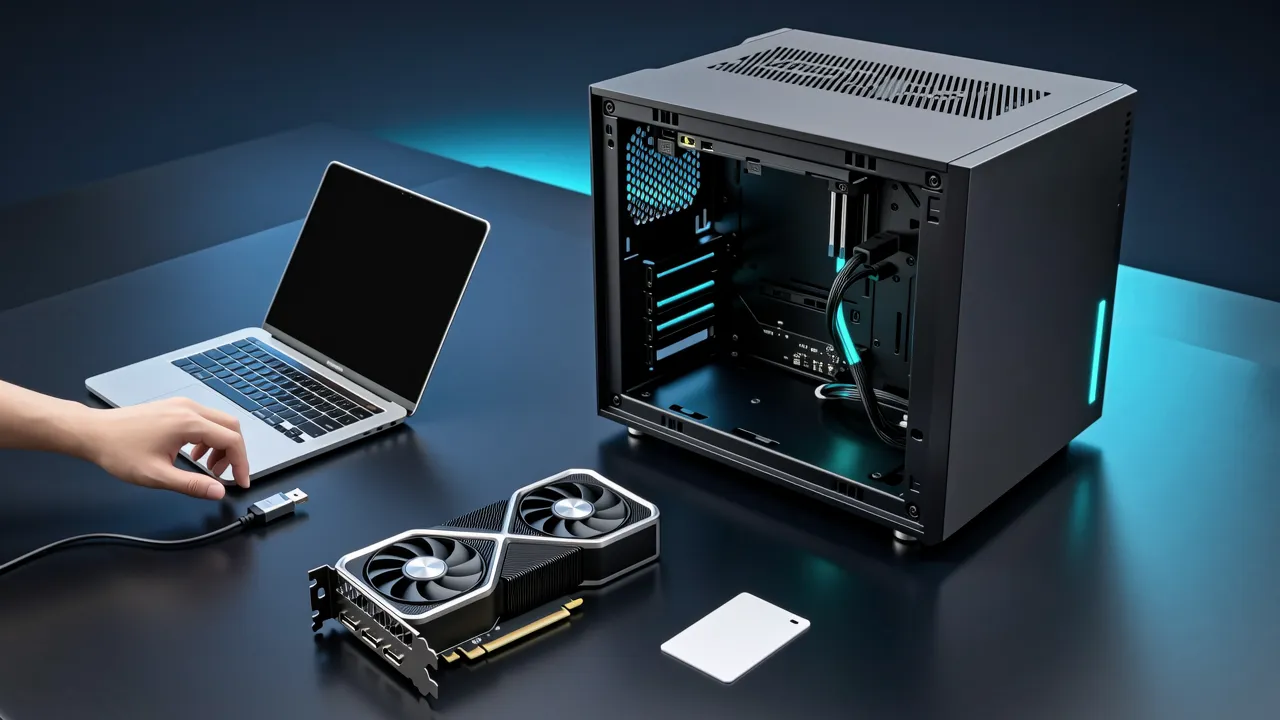
The two models differ mainly in scale. gpt-oss-120b has 117 billion parameters and can run on a single 80 GB GPU; gpt-oss-20b has 21 billion parameters and can run on devices with about 16 GB of memory [1][2]. Memory is the binding constraint in practice: parameters have to be stored and read while the model generates text, so a smaller model fits on cheaper hardware — one high-end graphics card in the first case, an ordinary workstation-class machine in the second. Parameters are the learned numbers that make up the model; more of them generally buy capability at the cost of memory and compute.
How OpenAI described performance
OpenAI compared the two releases against its o4-mini and o3-mini models [1]. It said gpt-oss-120b reached near-parity with o4-mini on core reasoning benchmarks, while gpt-oss-20b came close to o3-mini on common benchmarks [3]. A benchmark here means a standard set of test problems with scored answers, which lets different models be compared on the same tasks.
Training and features
Both models were trained with a mix of reinforcement learning and techniques drawn from OpenAI's internal frontier systems [3]. Reinforcement learning, in this setting, means rewarding the model for reaching answers that check out and letting it adjust its behaviour accordingly, rather than only imitating text written by people.
The pair also shipped with several controls. Adjustable reasoning effort lets a user trade more computation for a harder problem and less for an easy one. Full chain-of-thought means the model's intermediate reasoning is available rather than hidden away. Structured Outputs constrain a reply to follow a given schema, so that the result can be parsed directly by software [3].
Safety testing
Before release, OpenAI tested an adversarially fine-tuned version of gpt-oss-120b under its Preparedness Framework [3]. Adversarial fine-tuning means deliberately training a copy of the model to strip out its safety behaviour, in order to see what the model is capable of once those guardrails are gone — a check that is especially relevant for weights anyone can download and retrain.
Timing and tooling
The models were compatible with the Responses API [3], so applications built against that interface could call them in the same way as OpenAI's hosted models. The release came two days before GPT-5 [1].
Why it matters
Open-weight reasoning models change who can run and study a system. A model that fits on a single GPU or on a machine with roughly 16 GB of memory can be used without sending every request to a remote service, and a permissively licensed model can be inspected, fine-tuned and redistributed by outside researchers and developers. Publishing the weights also makes the safety question public: the adversarial fine-tuning test OpenAI ran is an attempt to characterise what happens when the same weights are pushed in a less careful direction [3].
[1]: Wikipedia, "Products and applications of OpenAI". [2]: GitHub, "openai/gpt-oss repository". [3]: OpenAI, "Introducing gpt-oss".
Sources
- 1Products and applications of OpenAIWikipedia
- 2
- 3Introducing gpt-ossOpenAI
Cite this page: OpenAI releases the open-weight gpt-oss models. TellWorld, https://www.tellworld.net/news/gpt-oss-2025. Updated 2026-11-08