Background
Before this release, Poolside's work had gone to government and public-sector clients that need air-gapped deployment[1]. An air-gapped system is one where the machines running the model are physically or logically cut off from outside networks, so nothing the model does can reach the open internet. That kind of customer imposes hard constraints: the model and everything around it has to run on hardware the customer controls, and it has to be obtainable without reaching out to a vendor's servers. Building for that audience shapes what a lab can ship and how it ships it.
What was released
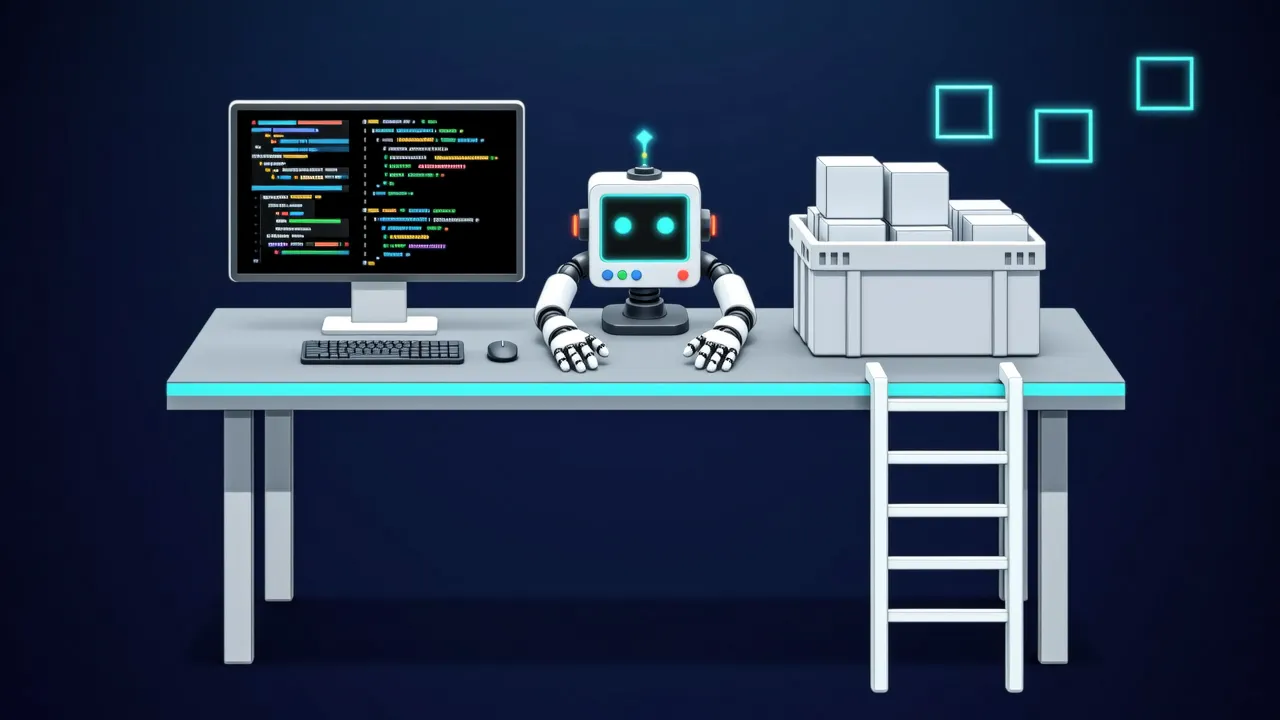
On 28 April 2026 Poolside published two coding models, Laguna M.1 and Laguna XS.2[1]. The release paired them with pool, the agent runtime that Poolside's own reinforcement learning runs on[1]. A runtime, or harness, is the layer between a model and the world: it decides what the model is allowed to do, feeds results back to it, and keeps the loop going. Shipping the harness alongside the models means the same machinery Poolside uses to train agents is the machinery outside users get.
The harness is an Agent Client Protocol server, and it was released as a research preview[1]. The Agent Client Protocol is a shared way for an agent to talk to the program hosting it — an editor, a terminal, or another client — so the agent does not need a separate integration for each host. Calling something a research preview means it is being put out for experimentation rather than delivered as a finished product.
Both models were free through Poolside's API and OpenRouter for a limited time[1]. OpenRouter is a routing service through which many models are reachable from a single interface.
Code instead of tool calls
Poolside argues that code is a more expressive interface for agents than a fixed set of tool-calling APIs[1]. The contrast is worth spelling out. In the tool-calling style, a developer declares a menu of functions — search, read a file, send a message — and the model picks from that menu; anything not on the menu is out of reach. Code is different. An agent that can write and run a program can compose operations, loop over data, branch on results, and express procedures nobody anticipated when the interface was designed. What it can attempt is bounded by the language rather than by the menu.
The company makes a related claim about scope: software creation is the core skill through which other agent capabilities get expressed[1]. On that view an agent that can write software is not one application among many, but the substrate other applications get built on.
Who built it
The Applied Research organisation behind the models has about 60 people[1].
Open weights, and where this sits
Poolside said it believes the West needs strong open-weight models and that it intends to keep contributing[1]. Open-weight models are ones whose trained parameters are published so that others can download, run and adapt them, rather than being reachable only through a vendor's API. For the air-gapped customers Poolside had been serving, that distinction is practical rather than abstract: a model you can hold is a model you can run on an isolated machine.
Taken together, the release puts into public view two things that had stayed inside the company: the models themselves, and the runtime used to train agents on them.
Sources
- 1Laguna: a deeper divePoolside
Cite this page: Poolside releases its first two Laguna coding models. TellWorld, https://www.tellworld.net/news/laguna-2026. Updated 2026-11-07