Background
Training a large language model takes a very large amount of computing power, and that computing power comes from clusters of accelerators working together over weeks or months. Which hardware and software stack a model is trained on therefore matters as much as the model architecture itself: a model trained on a "fully domestic" platform is one whose training run did not depend on imported accelerators and their associated software. iFlytek had been building its Spark family of models, and the V3.5 release was presented as the point at which that training stack was entirely domestic.
What was released
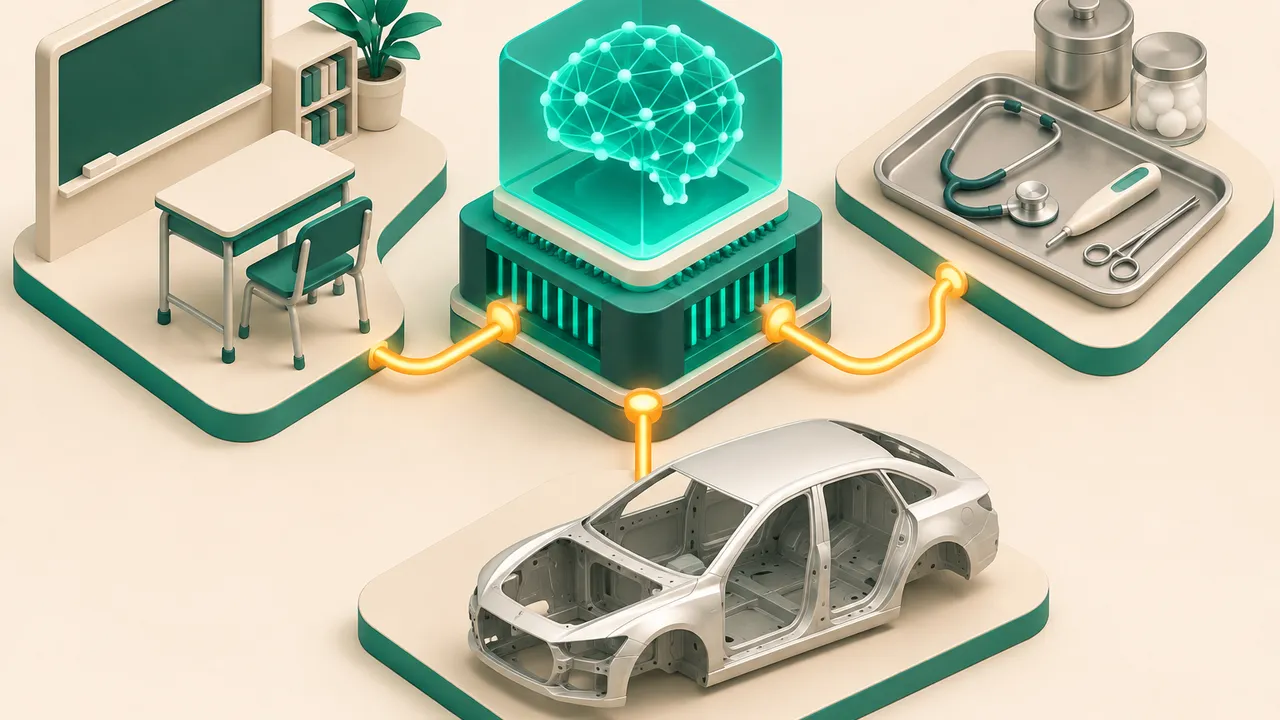
On 30 January 2024, iFlytek released Spark V3.5, which it described as the first Spark model trained on the fully domestic FlyingStar One platform[1]. The company said the new version had been upgraded across seven areas: language understanding, text generation, knowledge question answering, logical reasoning, mathematics, code and multimodal capability[1]. Two other models were launched at the same event: a Spark speech model, and an open-source model called Spark-13B[1].
The comparison claims
iFlytek claimed that Spark V3.5 beat GPT-4 Turbo in language understanding and mathematics, and that its coding ability stood at 96% of GPT-4 Turbo[1]. Its multimodal understanding was put at 91% of GPT-4V[1]. These are company claims about relative performance rather than absolute scores, and TechNode noted that iFlytek did not specify the criteria behind the comparisons[2] — which tests were used, how prompts were written, or how the results were scored. That makes the figures hard to check from outside, and they should be read as the company's own assessment of its model rather than as an independently verified ranking.
Speech and the open-source release
The speech model came with claims of its own. iFlytek said it beat OpenAI's Whisper V3 in speech recognition across the first 37 mainstream languages[1], and that its speech synthesis reached above 83% human-likeness across the first 40 languages[1]. Speech recognition is the task of turning audio into text; speech synthesis is the reverse, generating spoken audio from text, where "human-likeness" refers to how closely the generated voice resembles a human recording.
Spark-13B was described as the first open-source model built on the FlyingStar One platform[1]. iFlytek claimed it beat other open models of the same size by more than 20% in typical scenarios[1]. "Same size" here means models with roughly 13 billion parameters, the adjustable numbers inside a network that are set during training and that largely determine how much computation a model needs.
What it signalled
iFlytek said it expected to catch up with GPT-4's best level in the first half of 2024[1]. The release was therefore framed less as a finished product than as a step in a stated schedule, with the domestic training platform presented as the thing that made the schedule possible. For outside observers, the most checkable parts of the announcement are the ones that can simply be tried: an open-source 13B model is small enough to run and evaluate without special access, and speech models can be tested on ordinary audio. The comparisons with GPT-4 Turbo and GPT-4V, by contrast, remain the company's own numbers.
Sources
- 1
- 2
Cite this page: iFlytek releases Spark V3.5, trained on domestic compute. TellWorld, https://www.tellworld.net/news/spark-v3-5-2024. Updated 2026-11-08