Background
OpenAI's first step toward a coding agent was not in the browser. Codex CLI, an open-source coding tool for terminals, was released on 16 April 2025[3]. A terminal tool sits where developers already run builds and tests, and it can act on a project rather than only suggest the next line. The web product that followed a month later kept that idea but moved the work off the developer's own machine.
What launched
On 16 May 2025 OpenAI launched Codex, a web-based software-engineering agent inside ChatGPT, as a research preview[1][2]. Calling something a research preview signals that behaviour and access may change quickly, and in Codex's case they did. The agent was powered by codex-1, a version of the OpenAI o3 reasoning model[1][2] — that is, a model from a family built to work through steps before answering, adapted here for software work.
How a task ran
Two design choices defined the product.
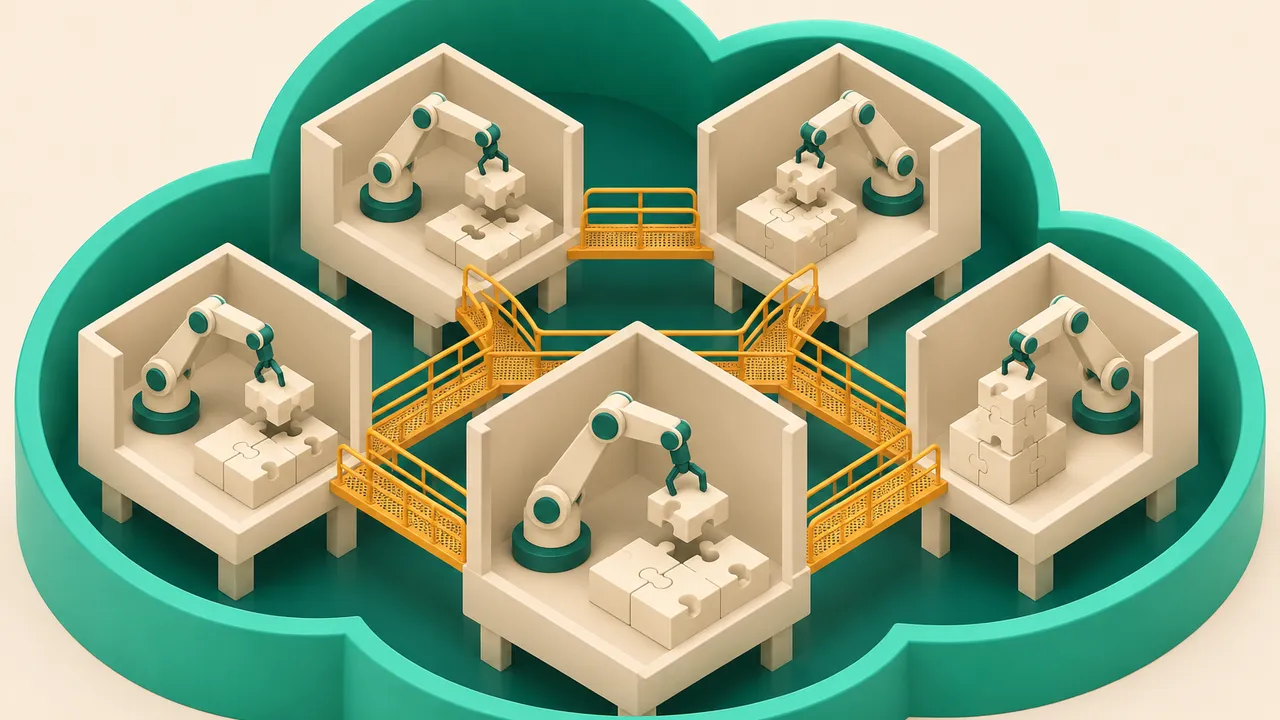
The first was isolation. OpenAI said each Codex task ran in its own cloud sandbox preloaded with the user's repository[1]. A sandbox is a contained environment: the agent gets a copy of the code and the tools to run it, inside a boundary that keeps its actions away from everything else. Because the repository is already loaded when a task begins, the agent does not have to be walked through the project's layout first.
The second was how it learned to finish work. Codex was trained with reinforcement learning on real-world coding tasks so that it could iterate on tests until it got a passing result[1]. Reinforcement learning trains a model by rewarding behaviour that leads to a good outcome; when the rewarded outcome is a passing test run, the model learns to write code, run the test suite, read the failure, revise, and try again — rather than producing one answer and stopping.
Who could use it, and when
At launch Codex went to ChatGPT Pro, Enterprise and Business users, with Plus and Edu to follow[1]. Access widened on 3 June 2025, when OpenAI opened Codex to Plus users and let it reach the internet during task execution[1]; the Plus rollout is also dated to June 2025 in later accounts[2]. Internet access changed the kind of task the agent could take on: work that depended on a library's current documentation or on an external service was no longer out of reach.
Why it matters
Codex marked a change in what a coding assistant was for. Earlier tools responded inside the editor, one suggestion at a time. A software-engineering agent is given a task — fix this, add that — and carries it out over many steps in an environment of its own, then returns with a result. The developer's role shifts from typing every line to describing the work and checking what comes back.
The dates also show how quickly the shape of the product settled: a terminal tool in April, a web agent in May, wider access and internet reach in June[1][2][3]. And the combination — a reasoning model as the engine, reinforcement learning on real coding tasks as the training method, and a per-task cloud sandbox as the setting — became a common template for agents meant to do work rather than answer questions.
Sources
- 1Introducing Codexopenai.com
- 2OpenAI CodexWikipedia
- 3
Cite this page: OpenAI launches the Codex software-engineering agent. TellWorld, https://www.tellworld.net/news/codex-agent-2025. Updated 2026-11-08