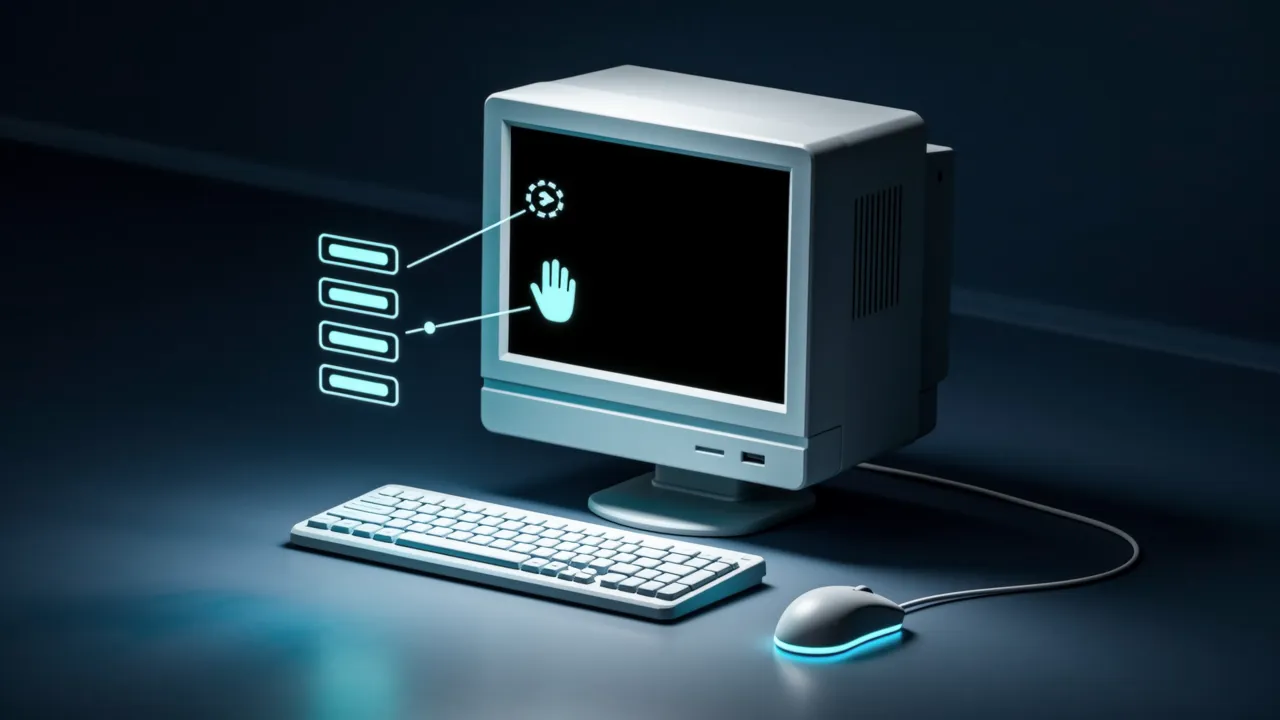
A long-standing practical test for AI systems is whether they can do work inside ordinary software — clicking, typing, reading a screen — rather than only producing text in a chat window. Computer use is what turns a model from an answer generator into something that can carry out a multi-step task in the same applications a person uses. GPT-5.4 was the release in which OpenAI made that capability standard on a general-purpose model.
Release
On 5 March 2026 OpenAI released GPT-5.4 in a Thinking version and a Pro version.[1] The company described it as the first general-purpose OpenAI model shipped with native computer-use capabilities, and said it combined the coding capabilities of GPT-5.3-Codex with better work across tools, software environments and professional documents.[3] It supported up to 1 million tokens of context.[3] Smaller variants, GPT-5.4 mini and GPT-5.4 nano, followed on 17 March 2026.[1]
Using the computer, and showing the plan
On OSWorld-Verified, a benchmark for completing tasks on a computer, GPT-5.4 scored 75%, above the 72.4% average human score.[1] OpenAI also said the Thinking version could show an upfront plan of its thinking, so that users could change course in the middle of a response.[3] Putting the plan on screen before the work is finished is a small interface change with practical consequences: a long task can be redirected early instead of being corrected only after it has run to the end.
Measured results
OpenAI reported GDPval 83.0% wins or ties, SWE-Bench Pro 57.7%, Toolathlon 54.6% and BrowseComp 82.7%.[3] It said the model made 33% fewer factual errors than GPT-5.2,[1][2] and described it as its most token-efficient reasoning model yet, using significantly fewer tokens than GPT-5.2.[3] Token efficiency matters for the kind of work computer use implies: an agent that takes many steps spends tokens on every step it reads, decides and acts on, so a model that needs fewer tokens per step leaves more room in a fixed budget for the task itself.
Reception
Reviewers praised its deep research but noted that it sometimes did not follow prompts accurately.[1] That mixed verdict is a reminder that benchmark numbers and day-to-day reliability are different things: a score describes an average over a fixed set of tasks, while a user notices the case where the instructions were misread.
Why it matters
GPT-5.4 sits where several lines of development meet. Native computer use pushes the model out of the chat box and into the applications where work actually happens; a context window of up to 1 million tokens lets a single session hold far more material; and the lower token use makes long, multi-step runs less expensive to carry out. The OSWorld-Verified figure is notable for a second reason: alongside the model's own score, it places a human baseline next to the machine result, which makes the comparison concrete rather than abstract. Benchmarks remain proxies, and OpenAI's own reported numbers are the company's measurements of its own model, but the direction is clear — the model is being judged on whether it can finish tasks, not only on how well it writes about them. The arrival of mini and nano versions less than two weeks later showed the capability moving quickly from a flagship release into a family of models at different sizes.[1]
Sources
- 1GPT-5.4Wikipedia
- 2
- 3Introducing GPT-5.4OpenAI
Cite this page: OpenAI releases GPT-5.4 with built-in computer use. TellWorld, https://www.tellworld.net/news/gpt-5-4-2026. Updated 2026-11-08