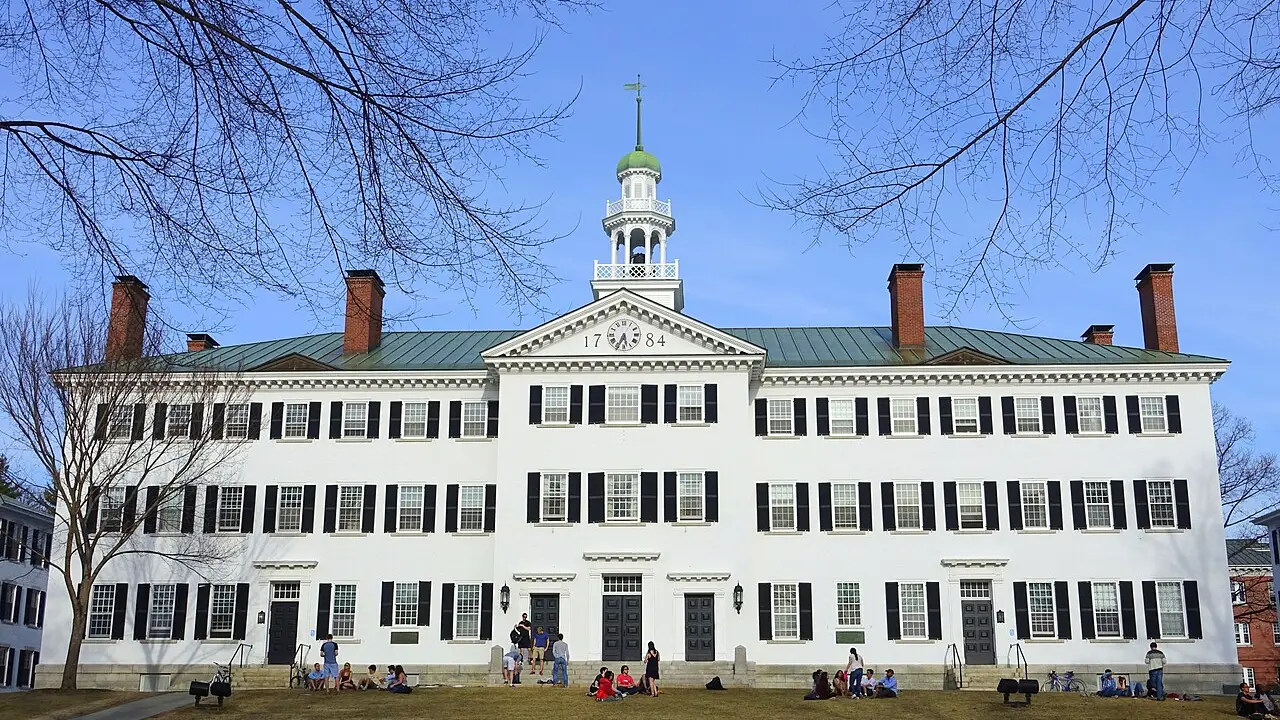
On 31 August 1955, John McCarthy, Marvin L. Minsky, Nathaniel Rochester and Claude E. Shannon dated a document titled "A Proposal for the Dartmouth Summer Research Project on Artificial Intelligence." McCarthy was at Dartmouth College, Minsky at Harvard University, Rochester at the IBM Corporation and Shannon at Bell Telephone Laboratories.[1] According to Grace Solomonoff's history, the four authors sent the proposal to the Rockefeller Foundation on 2 September 1955.[2]
Background
The idea had an earlier stage. In February 1955 McCarthy first approached the Rockefeller Foundation about a summer seminar for about 10 participants. The written proposal developed that plan into a request for a study of artificial intelligence.[2]
A written proposal made the request concrete. It named the subject, the length of the study, the number of participants, the topics and the cost.
What the proposal said
The proposal opens: "We propose that a 2 month, 10 man study of artificial intelligence be carried out during the summer of 1956 at Dartmouth College in Hanover, New Hampshire." Its working assumption is "the conjecture that every aspect of learning or any other feature of intelligence can in principle be so precisely described that a machine can be made to simulate it."[1]
That conjecture is the heart of the document. If learning and other features of intelligence can be described precisely enough, the authors argued, a machine can be built to carry them out. Every topic in the proposal rests on this assumption.
The word "conjecture" matters here. A conjecture is a claim to be tested, not a result already in hand. The authors did not say that machines could simulate intelligence; they proposed to study the question on that assumption over a summer. The list of topics that follows shows what they thought such a study should cover.
For a reader today, the document shows how the founders framed their goal at the start: not as one machine, but as a set of problems, from language and neuron nets to self-improvement and abstraction, each with its own open questions.
Key details
The document listed seven aspects of the "artificial intelligence problem": automatic computers, how a computer can be programmed to use a language, neuron nets, the theory of the size of a calculation, self-improvement, abstractions, and randomness and creativity.[1]
Under "Neuron Nets," it asked how a set of hypothetical neurons could be arranged to form concepts. It noted that partial results had been obtained, but more theoretical work was needed.[1]
The proposal asked the Rockefeller Foundation to fund the project. Its estimated expenses table gives a total of $13,500, mainly for the salaries, travel and rent of the participants.[1]
Influence
The document is credited with introducing the term "artificial intelligence." McCarthy chose the name partly for its neutrality, to avoid a narrow focus on automata theory.[2] The proposal was the basis for the workshop held at Dartmouth in the summer of 1956. McCarthy later noted in 1996 that this workshop produced no final report.[1]
Sources
- 1
- 2Ray Solomonoff and the Dartmouth Summer Research Project in Artificial Intelligence, 1956Grace Solomonoff (raysolomonoff.com)
- 3Artificial Intelligence (AI) Coined at DartmouthDartmouth College
Cite this page: Dartmouth AI summer research proposal is written. TellWorld, https://www.tellworld.net/news/dartmouth-proposal-1955. Updated 2026-11-07