Background
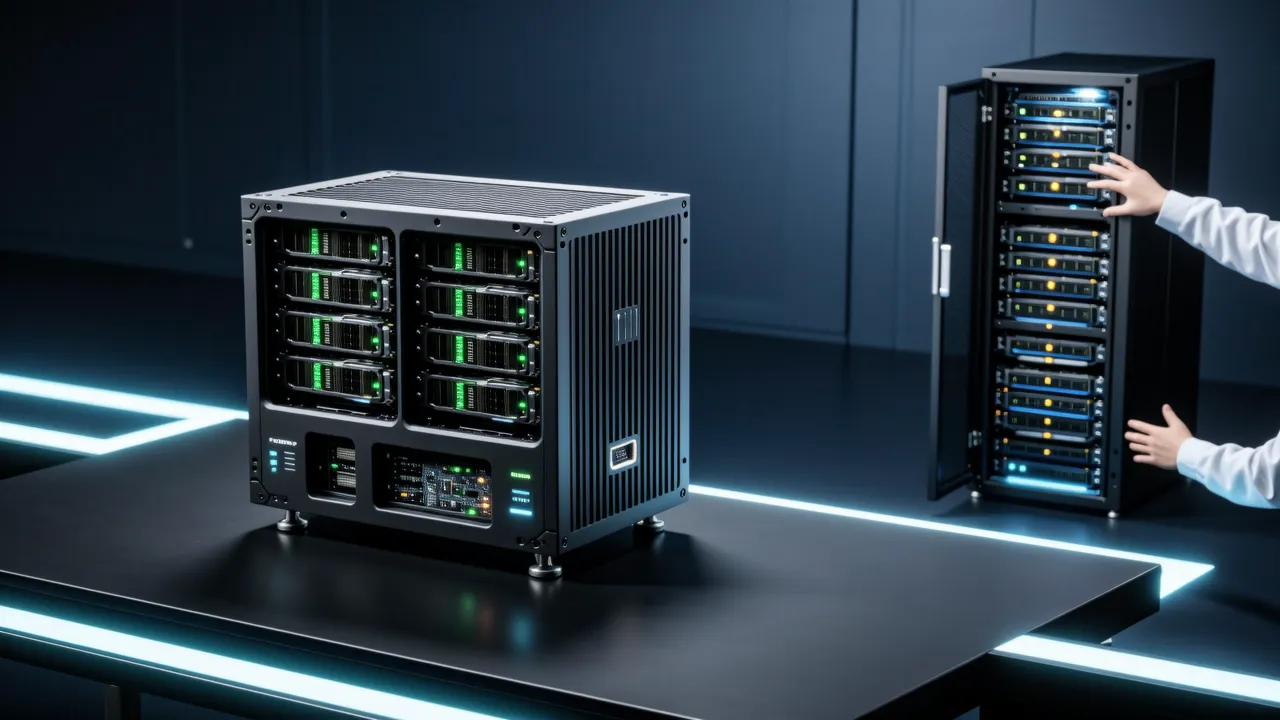
NVIDIA unveiled the DGX-1 on 5 April 2016 at GTC, presenting it as "the world's first deep learning supercomputer."[1] What the company was selling was not a single chip but a complete machine: hardware, deep-learning software and tools integrated into one turnkey box, which NVIDIA said matched the throughput of 250 x86 servers.[1] Systems were due to become available in the United States in June 2016.[1]
The timing reflected a change in how deep learning was done. Training a large neural network means performing an enormous number of simple numerical operations, largely matrix multiplications, over and over; GPUs, designed for graphics, turned out to be very good at exactly that kind of parallel arithmetic. Packaging that capability into one tuned machine meant a research group did not have to assemble and configure a cluster of its own before it could start training models.
The delivery
In August 2016 NVIDIA chief executive Jensen Huang hand-delivered the first DGX-1 to OpenAI's headquarters in San Francisco.[2] TOP500 reported the delivery on 15 August 2016.[2] OpenAI was at the time a young research organisation, and receiving unit number one of a new class of machine was an unusual gesture: the vendor's top executive carried the box in person rather than shipping it.
Inside the box
The system packed eight Tesla P100 GPUs with 16 GB of memory each, connected through an NVLink hybrid cube mesh.[1] NVIDIA rated it at up to 170 teraflops of FP16 performance — a teraflop here meaning a trillion floating-point operations per second, and FP16 the half-precision arithmetic commonly used for neural networks.[1] It also carried a 7 TB SSD cache, dual 10GbE and quad 100Gb InfiniBand networking, and drew 3,200 W in a 3U chassis.[1]
The bundled software was as much part of the product as the silicon: NVIDIA's DIGITS training system, the cuDNN 5 library, and optimised versions of the Caffe, Theano and Torch frameworks.[1] In practice that meant a team could bring its models to the machine without rewriting them from scratch for the hardware.
What OpenAI planned to do with it
TOP500 reported that OpenAI would use the machine for some of its most computationally challenging work, including generative modelling and conversational AI.[4] OpenAI research scientist Ilya Sutskever called it "a huge advance" that would let the team explore problems it could not attempt before.[4]
The start of a longer relationship
Looking back in October 2025, Huang described the moment: "I hand-delivered the first system to Elon at a small startup called OpenAI — and from it came ChatGPT."[3] NVIDIA noted that Elon Musk was among the team that received the first DGX-1 in 2016.[3]
The delivery later became a reference point for the two companies. When they announced a much larger infrastructure partnership on 22 September 2025, NVIDIA described the 2016 handover as the start of its long collaboration with OpenAI.[2]
Sources
- 1
- 2
- 3
- 4
Cite this page: NVIDIA delivers the first DGX-1 to OpenAI. TellWorld, https://www.tellworld.net/news/dgx-1-openai-2016. Updated 2026-11-08