Background
Model releases from large labs are usually families rather than single systems. One architecture and one training recipe are scaled to several parameter counts, and users pick the variant that matches their hardware and budget: a small one can sit on a laptop or inside an application, a large one needs servers and accelerators. LG AI Research took that route with EXAONE 3.5, whose technical report was published on 6 December 2024 [1]. The 7.8B member kept the size of its predecessor, so the release reads as an update of an existing line rather than a break from it [2].
What was released
The series covers three sizes — 2.4B, 7.8B and 32B — where "B" counts billions of parameters, the learned numbers that encode what the model has absorbed [1]. The weights were already available on Hugging Face from 1 December 2024, a few days before the report appeared, so people could download and run the models before the documentation describing them was public [2]. The release is licensed for research rather than for unrestricted commercial use [1].
The three sizes
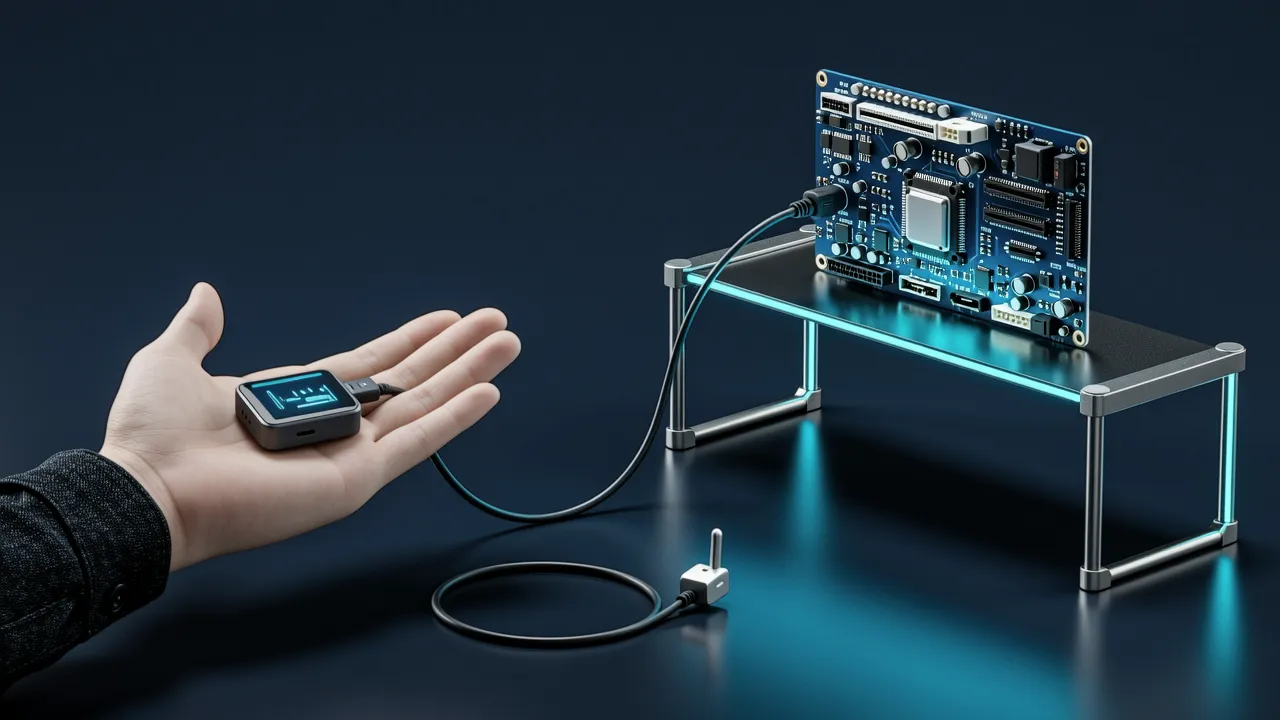
Each size has a stated role. The 2.4B is aimed at small or resource-constrained devices [2]: a model of that size is small enough to be shipped inside an application or run without a rack of accelerators, which is the point of training a tiny variant at all. The 7.8B keeps the size of its predecessor while improving performance [2] — the same footprint, so anyone already running the earlier model does not have to re-plan their hardware. The 32B is positioned as the high-performance member of the family, the one used where answer quality matters more than cost [2].
All three keep a 32K-token context window, and LG says they lead in long-context understanding [2]. The context window is how much text a model can hold in view while answering; 32K tokens is on the order of tens of pages, enough to read a long contract, a report or a source file in one pass instead of breaking it into chunks. Whether a model actually uses that space well — finding the right sentence in a long document — is a separate question, and here the claim is the company's own rather than an independent result [2].
Why the release matters
Two details in the announcement say more than the headline numbers. The first is order: the weights were on Hugging Face from 1 December, the technical report from 6 December [2][1]. Putting weights out before the documentation is a convention among labs that expect people to try a model first and read later, and it leaves early users sharing the job of describing how the thing behaves. The second is the licence. Research-only terms mean the models can be studied, evaluated and used in academic work, but not simply dropped into a commercial product without a separate arrangement [1].
The family structure is the third point. Because one series spans 2.4B to 32B, an organisation can start with the smallest model on a constrained device and move up to the 32B on servers while staying inside the same family, and the 32K context is held constant across the three rather than reserved for the largest [2]. Scale still buys capability — the 32B is the member positioned for the hardest work — but the choice is presented as a matter of deployment conditions as much as of raw quality [2].
Sources
- 1
- 2EXAONE-3.5-7.8B-Instruct model cardHugging Face
Cite this page: LG AI Research publishes the EXAONE 3.5 model series. TellWorld, https://www.tellworld.net/news/exaone-3-5-2024. Updated 2026-11-07