Background
A conventional search engine answers a query by matching text: the words a person types are compared with words on web pages, and the pages that match are returned as a ranked list of links. In that model the engine handles strings of characters but does not know what those characters refer to. The same word can name very different things, and different words can name the same thing, which a purely lexical comparison cannot sort out. The Knowledge Graph was Google's move in the other direction, from strings to things. Google described the launch as a critical first step towards building the next generation of search [1].
The announcement
Google announced the Knowledge Graph on 16 May 2012 [2]. The announcement was published on the Official Google Blog under the title “Introducing the Knowledge Graph: things, not strings” [1]. The title states the aim directly: rather than treating a query only as text, the engine would try to work out which entity that text refers to.
What the graph held
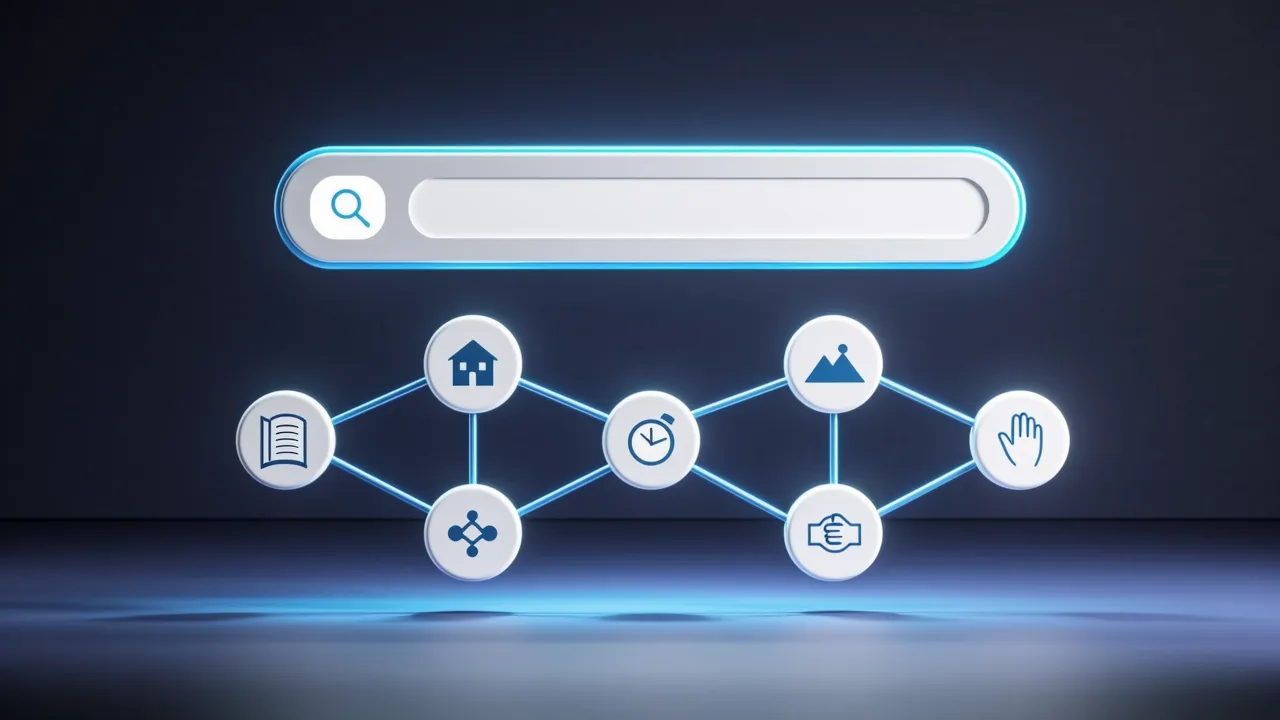
At launch, Google said the graph contained more than 500 million objects and more than 3.5 billion facts and relationships [1]. In a knowledge graph an object stands for a distinct entity — a person, a place, a building, a film — and the facts and relationships are the links between them: who was born where, who directed what, which place belongs to which region. Holding information in that shape lets a system connect two entities through a shared neighbour instead of through shared vocabulary. A query about a person, for instance, could be answered from links that already exist in the graph: a date of birth, an occupation, the works that person appeared in.
Google said the graph drew on public sources, including Freebase, Wikipedia and the CIA World Factbook [1]. These are public reference materials of different kinds: a database, an encyclopedia and a reference compilation of country data.
Rollout
Google said the feature would first reach users searching in US English, and that it would be available on smartphones and tablets as well as on personal computers [2]. The first release was therefore limited to one language, while being built for several kinds of device from the start.
What it did not do
The Economic Information Daily reported that the feature still needed a user to enter a query, and that it would not replace the ordinary list of links [2]. The graph therefore sat alongside the familiar ranked results rather than displacing them: a person still typed a query and still received a list of pages.
Why it mattered
Google presented the launch as a first step rather than a finished system [1]. The scale it reported at launch — more than 500 million objects and more than 3.5 billion facts and relationships [1] — described a base to which further entities and links could be added. The public framing, “things, not strings” [1], named a change in kind rather than in degree: search would try to identify entities and their connections, not only match words. No claim was made that the shift was complete. Coverage was limited to US English users [2], the feature still depended on a typed query, and the ordinary list of links remained in place [2]. What the announcement fixed, for readers at the time and afterwards, was the stated direction and the starting size of the graph.
Sources
- 1
- 2谷歌搜索引擎增加“知识图谱”功能经济参考报
Cite this page: Google launches the Knowledge Graph. TellWorld, https://www.tellworld.net/news/google-knowledge-graph-2012. Updated 2026-11-07