The problem it addresses
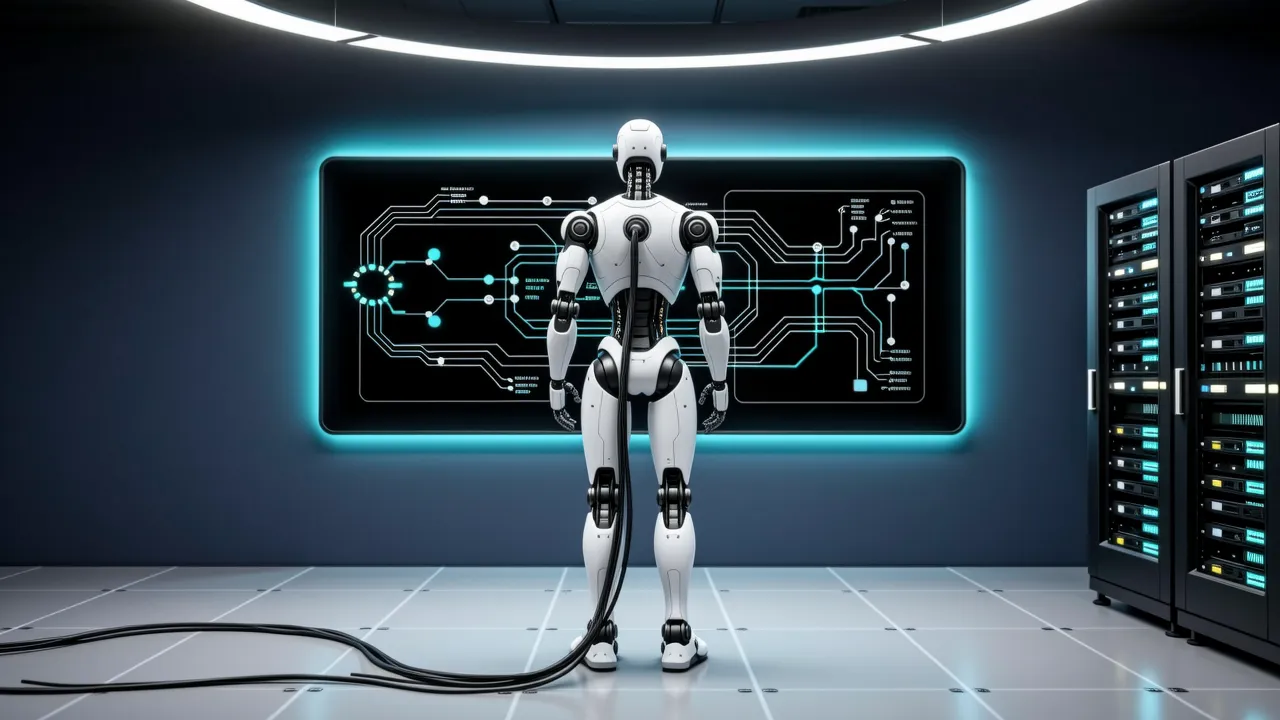
Most robots in use today are built for one job. A general-purpose robot — one that could handle an unfamiliar object, or move between a warehouse and a kitchen — needs a different kind of software: a model trained broadly enough to be adapted to many tasks instead of being written for a single one. In robotics this is usually called a foundation model, by analogy with the large pretrained models used for text and images.
NVIDIA put a number on the demand side of that argument. It said global labour shortages were estimated at more than 50 million people, and framed that gap as the market for generalist robotics [1].
What was announced
At its GTC conference in San Jose on 18 March 2025, NVIDIA announced Isaac GR00T N1 [1]. The company said the model was available immediately, and described it as the first of a family of fully customizable models that it would pretrain and release to robotics developers [1].
"Fully customizable" is the operative phrase. A pretrained model of this kind is a starting point rather than a finished product: it has already absorbed broad patterns from training data, and developers then adapt it to their own robot body, their own sensors and their own tasks. Handing such a model to outside developers, instead of keeping it internal, is what lets it serve as a common base layer across many robots rather than as one company's proprietary component.
The tools around it
The announcement was not only a model. NVIDIA said it was developing Newton, an open-source physics engine, together with Google DeepMind and Disney Research, and expected it to be available later in 2025 [1]. It also said it was collaborating with Google DeepMind on MuJoCo-Warp, which it expected to accelerate robotics machine-learning workloads by more than 70 times [1].
Physics engines matter to robot learning because practising in the real world is slow and expensive: hardware wears out, experiments are hard to repeat exactly, and many failures are costly. A simulator lets a model attempt a task thousands of times under controlled variation, and generates synthetic experience that can be mixed with real recordings. Faster simulation and faster machine-learning workloads both shorten that loop.
Alongside the model, NVIDIA released training data and task evaluation scenarios on Hugging Face and GitHub, and made the Isaac GR00T Blueprint available as an interactive demo [1].
Why it matters
A foundation model is only useful if people can build on it, and that requires more than weights. Developers need something to train on, a shared set of tasks to compare results against, and a way to try the thing before committing to it. Publishing data, evaluation scenarios and a demo alongside the model addresses all three, and putting the simulation engine in the open — with two outside research partners — signals that the surrounding tooling is meant to be shared rather than rented.
For the wider field, the announcement marks a shift in how humanoid robotics is being framed: not as a set of bespoke machines, but as an application of pretrained models, with the same pattern of pretraining, customisation and shared benchmarks that other areas of machine learning went through. Whether a generalist model transfers reliably to real hardware, on real robots, is the question developers will answer with their own machines.
Sources
- 1
Cite this page: NVIDIA announces Isaac GR00T N1. TellWorld, https://www.tellworld.net/news/gr00t-n1-2025. Updated 2026-11-08