Who this is for
This guide is for readers who already predict tracks or score variants with AlphaGenome 2 but are unsure what the imputation_mode column means. By the end you should be able to filter results by label and recognise which predictions should not be read as conclusions.
What an imputed track is
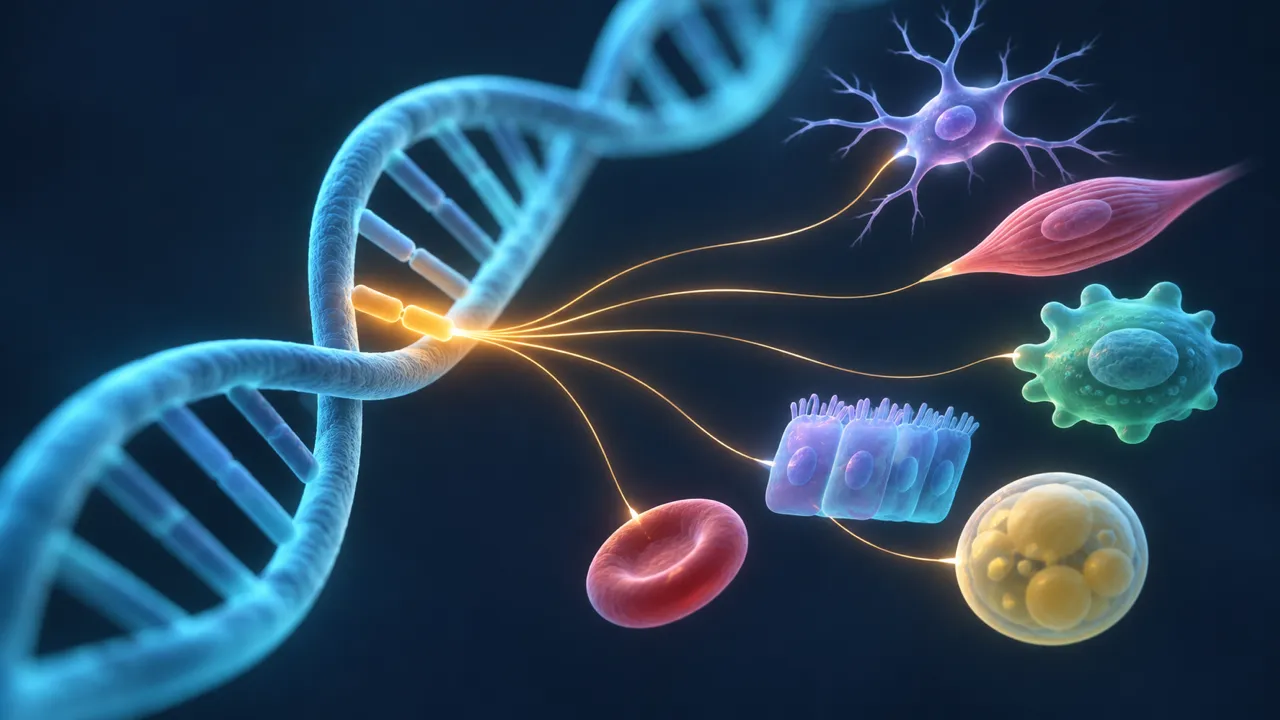
AlphaGenome 2 predicts every track for every condition, including tracks that were never measured experimentally in that condition. An imputed track is a model-generated hypothesis. It does not replace a measurement[1]. Check the label before you use a track.
The three labels
Each track carries an imputation_mode label with one of three values[1]:
observed: the track was experimentally measured in that condition and used in training[1].imputed_supported: the track was not measured in that condition, but it is inferred in a direction that makes biological sense and has been benchmarked, for example predicting histone marks from chromatin accessibility[1].imputed_exploratory: the condition's measured assays do not reliably constrain this readout. Performance is not benchmarked and can be poor or systematically misleading[1].
Channels, tracks and modalities
Each output type predicts a fixed set of channels, and a track is one channel in one condition[1]. For most assays, the channels are technical variants of the same readout, such as the sequencing protocol, polyA+ versus total RNA, or the forward + and reverse - strands. Only ChIP-seq (CHIP_HISTONE and CHIP_TF) has channels that stand for distinct biological targets, namely histone marks or transcription factors[1].
A condition usually profiles one protocol or assay per modality rather than every variant, so imputation fills in the rest[1]. There are two cases:
- Within-modality imputation applies when at least one assay of the modality was measured in the condition, and the model fills in the rest. For example, ATAC-seq can be imputed when DNase-seq was measured[1].
- Across-modality imputation applies when none of a modality's channels were measured. In bone marrow T cells, which only have single-cell assays, all histone ChIP-seq channels are imputed from scATAC-seq and scRNA-seq[1].
Which outputs can be supported
Whether an output can be labelled as supported depends on which modalities the condition measured[1]:
- Chromatin accessibility (
ATAC,DNASE,SC_ATAC) can be supported when accessibility and/or gene expression was measured[1]. - Gene expression (
RNA_SEQ,SC_GENE_EXPRESSION) can be supported when accessibility and/or gene expression was measured[1]. - Histone modifications and CpG methylation (
CHIP_HISTONE,METHYLATION) need measured accessibility. Gene expression alone is not sufficient[1]. - TF binding (
CHIP_TF), splicing (SPLICE_SITES,SPLICE_SITE_USAGE,SPLICE_JUNCTIONS), transcription start sites (CAGE) and 3D chromatin contacts (CONTACT_MAPS) are always imputed_exploratory when unmeasured[1].
Labels under expression conditioning
When you pass your own human single-cell counts with cell_conditioning=, no track is labelled observed. The counts do not correspond to a reference condition. Single-cell gene expression is predicted directly from your cells, and the other modalities are imputed from the cell embedding under the same reliability rules[1].
Filtering by label in code
supported_conditions() has one row per condition and one column per output type. Each column shows the best label among that output type's channels. So observed means at least one channel was measured, not all of them. If only CTCF was profiled, the transcription factor column reads observed, while the other 777 factors remain exploratory[1].
Every track in a prediction or score table has its own label in the imputation_mode column. To keep only measured tracks[1]:
# Keep only directly measured tracks on an Output or GeneExpressionData object:
observed_rna = output.filter_to_observed().rna_seq
To keep measured tracks and supported imputations while dropping exploratory ones, filter the scores like this[1]:
# Keep measured tracks and supported imputation hypotheses:
tidy = variant_scorers.tidy_scores(scores)
supported_scores = tidy.query(
    'imputation_mode in ["observed", "imputed_supported"]'
)
Common misreads
Splicing from single-cell data needs care
Many primary cell types have only 3' or 5' UMI scRNA-seq (SC_GENE_EXPRESSION) or scATAC-seq (SC_ATAC), and so do all expression conditioning inputs. Droplet end-tag reads do not span internal splice junctions, so they give no direct supervision on cell-type-specific exon inclusion[1].
The model learns DNA splice donor (GT) and acceptor (AG) motifs. It can therefore place constitutive exon boundaries that look realistic on REF tracks. Tissue-specific alternative splicing, which is controlled by trans-acting RNA-binding proteins, remains unconstrained[1].
When RNA_SEQ is imputed_supported from single-cell assays alone, the total gene-level expression level is well supported. Relative coverage across individual exons should not be read as validated isoform usage[1].
A practical rule: score SPLICE_SITES, SPLICE_SITE_USAGE and SPLICE_JUNCTIONS only where the splicing tracks are observed or bulk full-length RNA_SEQ was measured. In single-cell-only conditions, assess total transcriptional effects with SC_GENE_EXPRESSION_DENOISED (under expression conditioning) or SC_GENE_EXPRESSION (with condition=)[1].
False positives from unexpressed transcription factors
TF ChIP-seq experiments are almost always run in cell types where the target factor is expressed. During training, unmeasured (condition, TF) tracks were masked from the loss rather than given zero signal. The model was therefore never explicitly taught that unexpressed factors do not bind DNA[1].
When a variant falls in open chromatin and matches a transcription factor motif, imputed CHIP_TF tracks and ALT minus REF scores can be large even if that factor's gene is not expressed in the condition. The same holds for expressed paralogs from the same motif family, such as ETS, GATA or KLF/SP proteins[1].
Keep CHIP_TF tracks and scores to imputation_mode == 'observed' whenever possible. For imputed_exploratory results, confirm that the candidate factor's gene is expressed in that condition. The snippet below checks single-cell expression across the gene's own 1 Mb interval, then filters scores against a list of factors you know are expressed[1]:
# Check expression of a candidate TF gene on its own 1 Mb genomic interval:
tf_pred = dna_model.predict_interval(
    interval=tf_gene_interval.resize(dna_client.SEQUENCE_LENGTH_1MB),
    requested_outputs=[dna_client.OutputType.SC_GENE_EXPRESSION],
    condition=condition,
)
sc_gex = tf_pred.sc_gene_expression.filter_to_observed()

# Or filter candidate TF ChIP-seq variant scores against a predefined set of TF
# gene symbols expressed in your condition (for example, from your own RNA-seq):
expressed_tf_symbols = {'SPI1', 'CEBPA', 'IRF8'}
valid_tf_scores = tidy[
    (tidy['output_type'] == 'CHIP_TF')
    & (
        (tidy['imputation_mode'] == 'observed')
        | tidy['transcription_factor'].isin(expressed_tf_symbols)
    )
]
Next steps
The official walkthrough, Working with imputed tracks, uses the TCF7 locus to show both within-modality and across-modality imputation[1]. Running that example after this guide makes the labels easier to map onto real results.
Adapted from the AlphaGenome documentation's section on imputed tracks by Google DeepMind[1], released under the CC-BY-4.0 license.
Sources
- 1Navigating imputed tracksGoogle DeepMind AlphaGenome docs
Cite this page: Reading imputed tracks in AlphaGenome 2. TellWorld, https://www.tellworld.net/practice/practice-alphagenome-2-imputation. Updated 2026-11-15