Background
Landing a rover on Mars is one of the harder problems in spaceflight. A spacecraft arrives at interplanetary speed and has to lose almost all of it within a few minutes, in an atmosphere too thin to do the whole job by itself. NASA's Curiosity rover was headed for the floor of Gale Crater, and the descent was built around a sequence that ended not with a rocket landing on legs, but with a descent stage that lowered the rover to the ground on a tether[1][2].
The landing
Curiosity landed successfully on the floor of Gale Crater on 6 August 2012 Universal Time, which was the evening of 5 August in Pacific Time[1]. NASA put the start of the entry, descent and landing phase at about 125 kilometres above the surface, and the moment the rover was on Mars at 10:32 p.m. PDT on 5 August 2012[3].
How the descent worked
The spacecraft entered the atmosphere at about 5,800 metres per second[3]. About 240 seconds later, at an altitude of roughly 10 kilometres, it deployed its parachute[3].
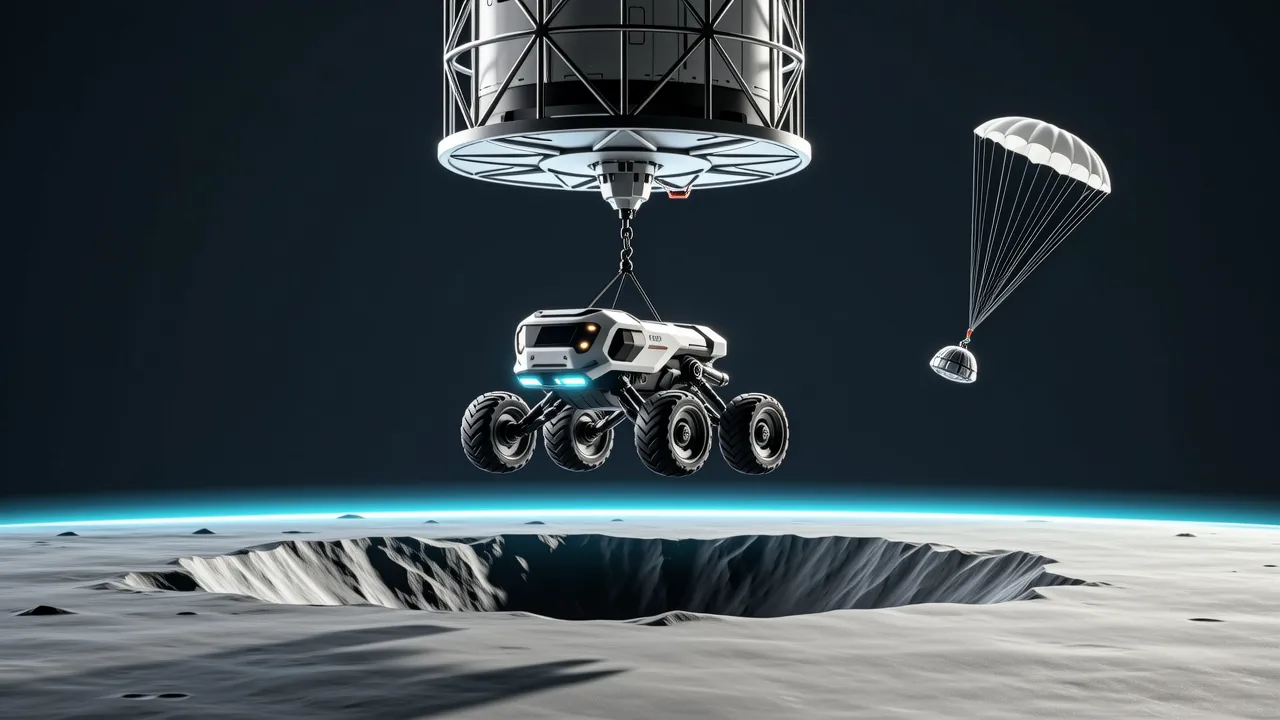
The final stage is the part that made this landing distinctive. The descent stage lowered the rover on a tether rather than setting it down directly; after touchdown it cut the cords and flew off to a controlled crash landing, out of range of the rover[2]. NASA describes the rover separating from the descent stage while still attached by the sky crane bridle at an altitude of about 20 metres, with about 12 seconds left before touchdown[3]. Just before contact the rover's wheels and suspension popped into place, and it arrived on the surface at about 0.75 metres per second[3].
Why the last seconds are the hard part
By the time the rover is hanging about 20 metres up with roughly 12 seconds to go, there is no room for anyone to intervene; the sequence — lower, touch down, cut the cords, fly away — has to run on its own[2][3]. The descent stage does not land. It separates and departs, so what ends up on the surface is the rover alone, with its wheels and suspension deployed[2][3].
Because radio signals take minutes to travel from Mars to Earth, the team could not follow the descent in real time. NASA says its team waited about seven minutes for the signal confirming that the landing had worked[2].
What it left behind
The immediate result was a rover standing on the floor of Gale Crater, its wheels and suspension in place and its delivery vehicle gone[1][3]. The landing also put the whole sky crane sequence on the record as a working procedure: a parachute descent, a tether lower, an automatic cut, and a descent stage that took itself out of the way instead of coming down on top of the rover[2][3].
Sources
- 1
- 2
- 3How We Land on MarsNASA Science
Cite this page: Curiosity lands on Mars. TellWorld, https://www.tellworld.net/news/curiosity-landing-2012. Updated 2026-11-07