Background
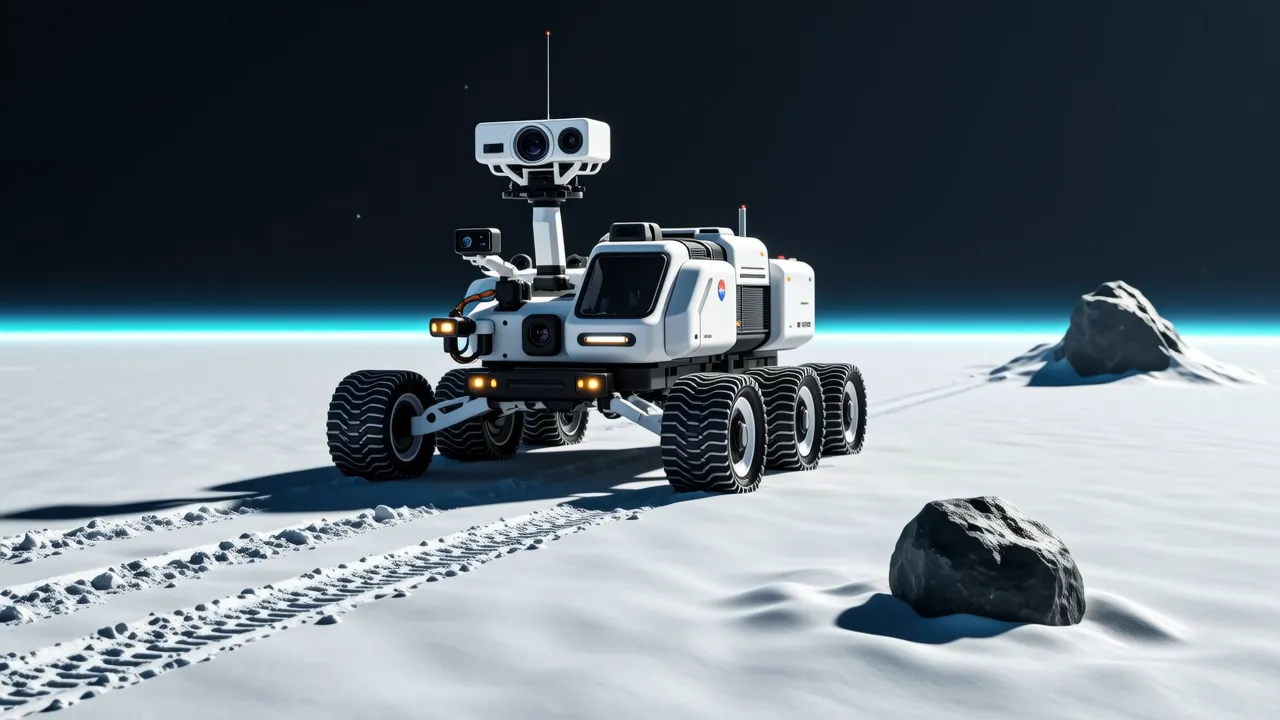
Nomad is a planetary rover prototype funded by NASA and built at Carnegie Mellon University's Robotics Institute, with William L. Red Whittaker as principal researcher and Dimitrios Apostolopoulos as project manager [1]. A rover prototype is a mobile robot built to carry instruments across a surface, tested somewhere on Earth that stands in for the place it is ultimately meant to work. On January 26, 2000, Carnegie Mellon issued a news release announcing Big Signal, an interactive Web site built around a robot named Nomad searching for meteorites in Antarctica [1]. A meteorite is a piece of rock from space that has survived the fall to the ground; Antarctica is one of the places where organized meteorite searches are carried out, and this expedition was a collaboration with the National Science Foundation's Antarctic Search for Meteorites program [3].
What happened
The search area was Elephant Moraine in eastern Antarctica, 160 miles northwest of McMurdo Station [3]. The BBC reported that the expedition marked the first time a robot had been used to discover extraterrestrial material that had fallen to Earth [2]. The claim is about the find rather than the trip: the material was located through a machine's instruments, not by a person walking across a snowfield.
Key details
According to the BBC, the robot carried stereo cameras, a high-resolution camera, a spectrometer and a metal detector, and it radioed the GPS coordinates of candidate meteorites back to researchers [2]. The instruments answer different questions. A pair of stereo cameras gives two views of the same scene, and the difference between them yields the distance to an object. A high-resolution camera records finer detail. A spectrometer measures the light coming off a target so that its composition can be estimated. A metal detector flags rocks containing metal. GPS gives the position of a find, so that someone can return to it.
The BBC quoted Whittaker saying that this time Nomad would make its own judgments and inferences about the rocks it encounters, rather than returning pictures and data for scientists to interpret [2]. That is a shift in where the filtering happens: instead of sending everything home for people to sift through, the rover was to decide what was worth reporting. Doing that on the spot matters most where a vehicle cannot count on a person at the other end of the link to look at every frame.
A public window
Big Signal was a two-year project directed by Peter Coppin of the STUDIO for Creative Inquiry, and it gave users access to Nomad's sensors, including a 360-degree panoramic camera [1]. The site put the rover's own readings in front of outside visitors, so the search could be followed through the instruments rather than only through a summary written afterwards.
After
NASA gave Coppin and colleagues a three-year, 500,000 dollar grant to develop EventScope, an enhanced system based on Big Signal [1]. The line from the Antarctic trial therefore ran in two directions at once: toward robots that judge rocks for themselves, and toward interfaces that let people elsewhere watch a field expedition as it happens.
Sources
- 1Carnegie Mellon interactive web site Big SignalCarnegie Mellon University (EurekAlert)
- 2Robot hunts for space rocksBBC News
- 3Robot Alone Via AntarcticaSpace Daily (CMU release)
Cite this page: Nomad autonomously searches for meteorites in Antarctica. TellWorld, https://www.tellworld.net/news/nomad-antarctica-2000. Updated 2026-11-07