Background
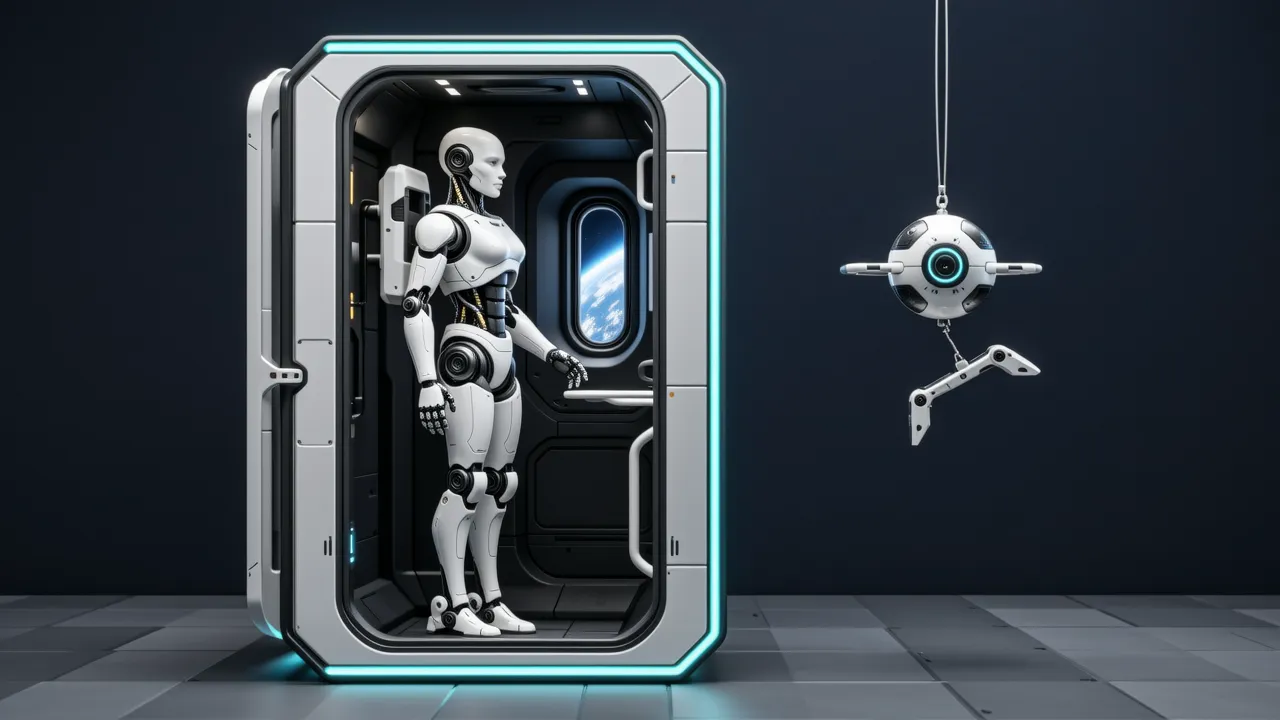
Robonaut 2 — R2 for short — was developed jointly by NASA and General Motors under a cooperative agreement [1]. It is a humanoid, meaning a robot built to resemble the human body, typically with a torso, a head and two arms; NASA describes it as the first human-like robot sent to space [1].
What happened
R2 reached orbit on 24 February 2011 aboard the space shuttle Discovery, on the STS-133 mission [1]. It travelled inside the Permanent Multipurpose Module, a module that also carried equipment and supplies for the station [2].
The flight was also notable in its own right. STS-133 was Discovery's 39th and last scheduled flight, the 133rd shuttle mission, and the 35th flight to the space station [2]. The six-member crew was led by Commander Steve Lindsey, on his fifth spaceflight [2].
The details
R2 did not arrive as a walking machine. It was initially deployed as a torso-only humanoid, restricted to a stanchion; a mobility platform was added only in 2014 [1]. The purpose of sending it up was to test it in microgravity and to subject it to the station's radiation and electromagnetic interference [1]. Microgravity means the robot is in continuous free fall and effectively weightless; radiation and electromagnetic interference are features of the space environment that are hard to reproduce completely in a ground laboratory.
NASA was clear about the limits. R2 was still a prototype and did not have the protection needed to exist outside the space station [1]. Its working space was therefore inside the station rather than out in vacuum.
Why it matters
R2's flight took the humanoid robot out of the laboratory and into a working environment where weight is absent and radiation and electromagnetic interference are everyday conditions — a setting that can only be checked by sending the machine there [1]. Its configuration changed over time: from a torso-only humanoid tied to a stanchion to a version with a mobility platform added in 2014 [1]. Because it was a prototype without external protection, the testing it could do was bounded by the inside of the station, and the robot's value lay in what its time there showed about running a human-shaped machine in a place built for people.
Sources
- 1
- 2STS-133 The Mission press kitNASA Kennedy Space Center
Cite this page: Robonaut 2 becomes the first humanoid robot in space. TellWorld, https://www.tellworld.net/news/robonaut2-launch-2011. Updated 2026-11-07