Background
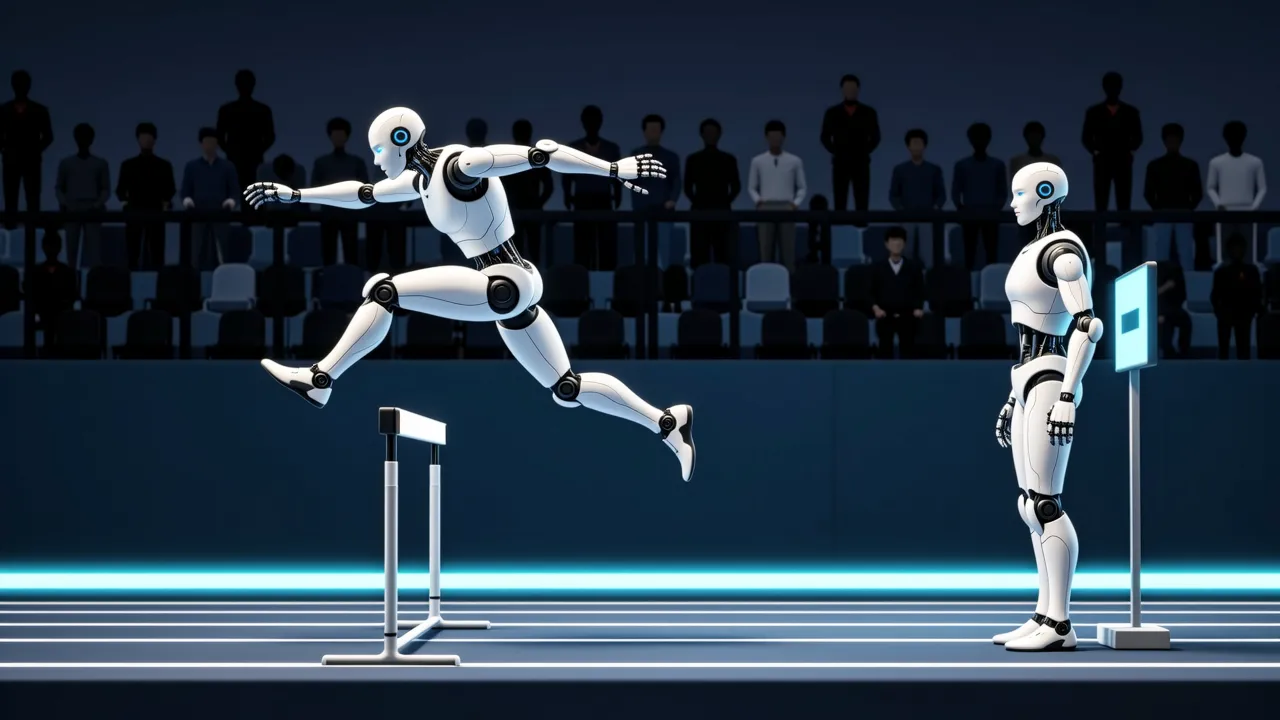
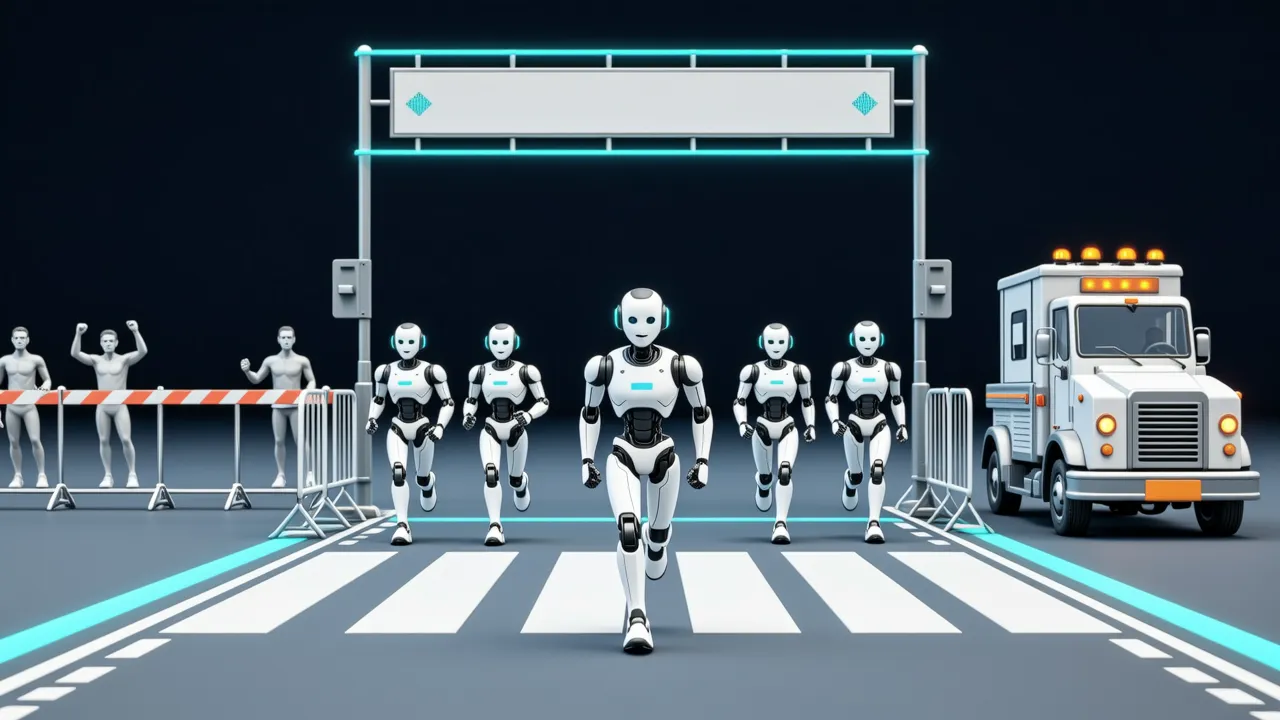
The humanoid half marathon was held alongside the 2025 Beijing Yizhuang Half Marathon. Twenty robot teams took part, coming from Beijing, Shanghai, Guangdong, Ningxia and elsewhere[1][2]. The machines and the human runners covered the same 21.0975 km course, from Nanhaizi Park to Tongming Lake, but each group ran on its own track rather than sharing the road[1].
What happened
The race started at 07:30 on 19 April 2025[1][2]. Tiangong Ultra came home first, in 2 hours 40 minutes 42 seconds[1][2]. A team running the Songyan Power N2 was second[1][2]. Third place went to the Xingzhe-2 team, which, as the China Securities Journal reported, finished without changing its battery or swapping in another robot[2].
The course and the rules
The route was built to be harder than a flat loop. It included steep slopes and railway tracks, six left turns and eight right turns, and it ended with a 1.5 km finishing straight[1]. Each of these puts a different demand on a walking machine: a slope loads the leg joints and motors and changes how much energy every step costs; railway tracks are uneven ground that has to be stepped over rather than walked around; a turn asks the robot to steer and shift its weight without falling; and the long straight at the end tests whether the power supply and the cooling can still hold up after more than two hours of continuous walking.
The rules allowed teams to change batteries and to replace a robot during the race, but both carried time penalties[2]. That made reliability part of the result. A team could keep going with a fresh battery pack or a spare machine, but every swap pushed it down the order, so the best performances came from finishing on one battery and one robot. The Xingzhe-2 team's third place stood out for that reason: it covered the distance with no battery change and no robot change[2].
Why it matters
Liang Liang, deputy director of the Beijing Economic-Technological Development Area, described the race as a platform for verifying, testing and displaying the industry[1][2]. That framing points at what a public race adds to a laboratory demonstration. A demonstration can be arranged around what a machine does well; a race sets the same task for everyone, runs it once, in public, on a fixed course, with a clock. Failures — a fall, a stalled joint, an overheated part, a battery that runs flat — happen in front of spectators and get reported alongside the finishing times.
The results also marked where bipedal robots stood. Two hours and forty minutes for 21.0975 km is far slower than the times of competitive human distance runners, and long stretches of the race would have been walked rather than run[1][2]. For an industry still working on endurance, that gap is part of the point of holding the event: it gives teams a shared benchmark, and gives the public a result that can be compared as the machines improve.
Sources
- 1
- 2
Cite this page: First humanoid half marathon held in Beijing. TellWorld, https://www.tellworld.net/news/beijing-half-marathon-2025. Updated 2026-11-08