A company that licenses rather than sells
Arm Limited designs processor cores and the instruction sets that software is written against, then licenses those designs to other companies, which build them into their own chips. Because its customers include firms that compete with one another, Arm's commercial position depends on being seen to treat all of them the same way. Any change in who owns Arm therefore touches the whole chip industry, not just one company's product line.
The announcement
On 13 September 2020, NVIDIA and SoftBank Group announced a definitive agreement under which NVIDIA would acquire Arm Limited from SoftBank and the SoftBank Vision Fund.[1] The transaction was valued at $40 billion, to be met through a combination of NVIDIA shares and cash.[1]
How the price was built
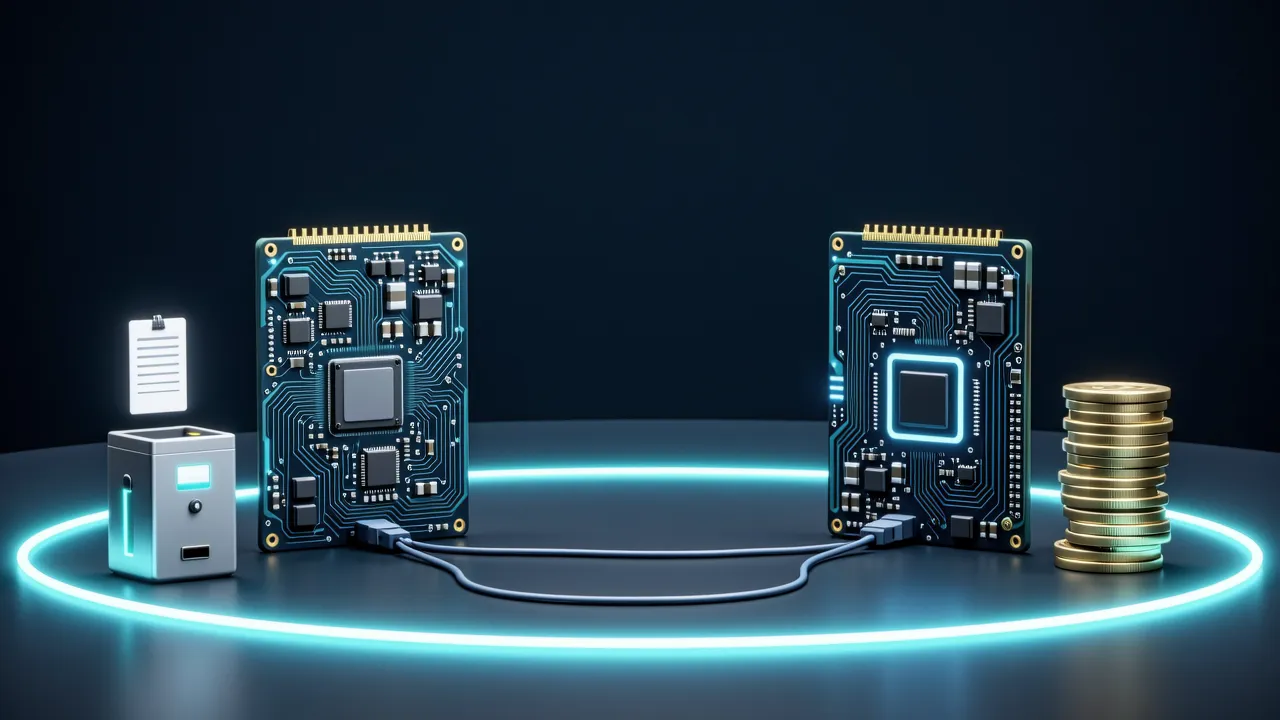
Under the terms, NVIDIA would pay SoftBank $21.5 billion in NVIDIA common stock and $12 billion in cash, including $2 billion payable at signing.[1] The number of NVIDIA shares to be issued at closing was 44.3 million, a figure determined using the average closing price over the last 30 trading days.[1] SoftBank could additionally receive up to $5 billion in cash or common stock under an earn-out construct tied to Arm's financial performance, so part of the consideration depended on how Arm's business did after the deal.[1] Separately, NVIDIA agreed to issue $1.5 billion in equity to Arm employees.[1] The transaction did not include Arm's IoT Services Group, which stayed outside the deal.[1]
Promises about how Arm would be run
Because Arm licenses to much of the industry, the question of neutrality was central. NVIDIA said Arm would continue its open-licensing model and its customer neutrality, noting that Arm licensees had shipped 180 billion chips to date.[1] On location, Arm would remain headquartered in Cambridge, where NVIDIA planned a global centre of excellence in AI research as well as an Arm-powered AI supercomputer.[1] Both commitments addressed the same worry: that a chip designer bought by a chip company might favour its owner, or that its engineering base might be pulled elsewhere.
What still had to happen
Completion was subject to regulatory approvals in the UK, China, the EU and the US, and was expected in about 18 months.[1] Four jurisdictions meant four separate reviews, each able to hold up or block the transaction on its own timetable — an unusual amount of regulatory surface for a single acquisition.
Why it drew attention
The deal joined two very different positions in computing. NVIDIA was paying for the design portfolio and licensing business that sits underneath a large part of the world's computing, while presenting the purchase as a bet on AI. The structure described on the day — a mix of stock, cash, an earn-out, employee equity and a carved-out IoT unit — shows how much of the negotiation was about price and risk-sharing rather than about the products themselves. The stated expectation of about 18 months, and the list of four regulators, also set out in advance how long and how uncertain the path from signature to closing would be.[1]
Sources
- 1
Cite this page: NVIDIA agrees to acquire Arm from SoftBank for $40 billion. TellWorld, https://www.tellworld.net/news/nvidia-arm-acquisition-2020. Updated 2026-11-07