The launch
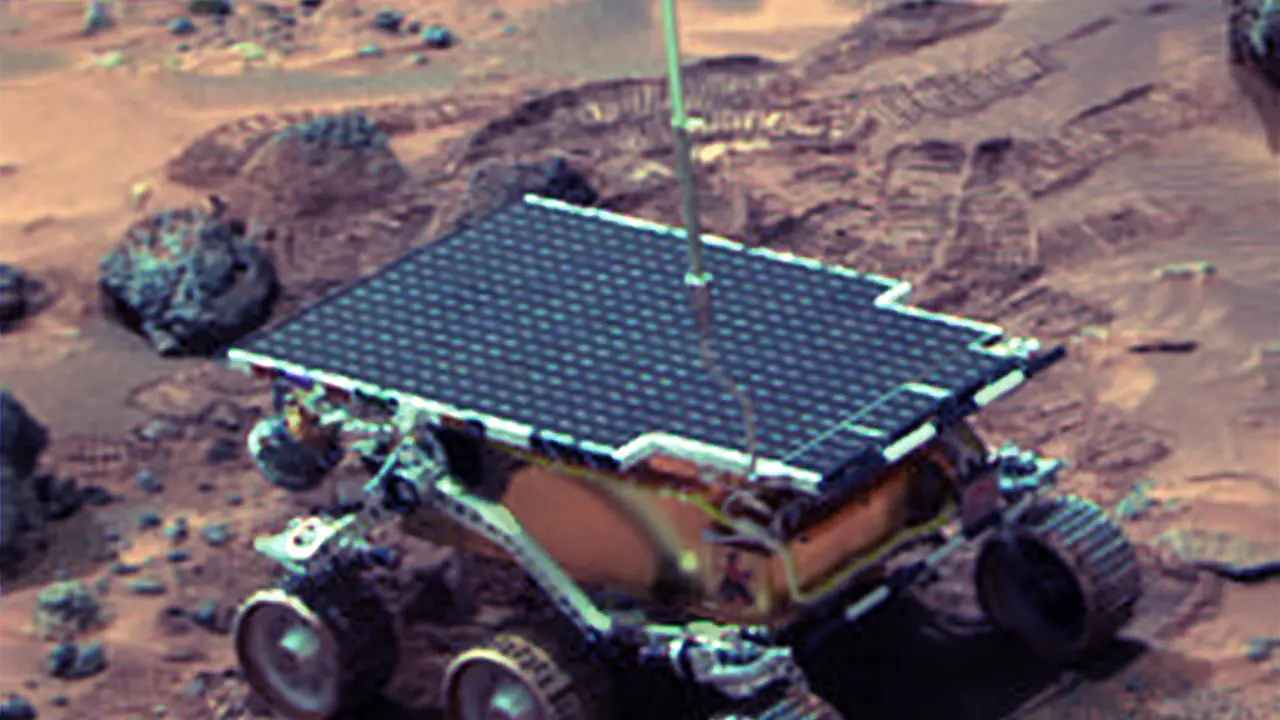
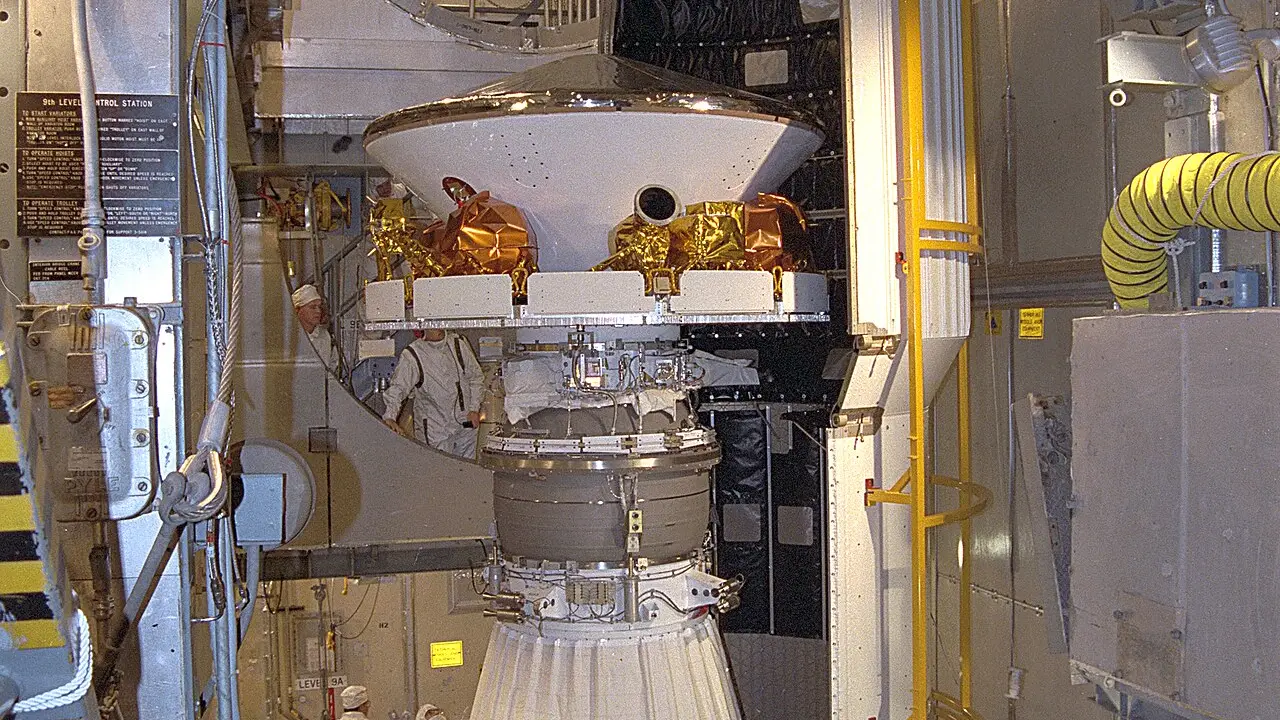
Mars Pathfinder lifted off on December 4, 1996, from Launch Complex 17B at Cape Canaveral Air Force Station in Florida.[1] It rode to space on a Delta II 7925 rocket.[2] The mission was not a single craft but a pair: a lander, and a small rover named Sojourner that the lander was to deploy on the surface.[1]
The cruise to Mars
The trip to Mars took 212 days. During that interplanetary cruise, four mid-course corrections refined the spacecraft's trajectory.[1] Cruise is the long middle stretch of a planetary mission: the spacecraft is on its way, there is little for the science instruments to do, and the main work is navigation. Over hundreds of millions of kilometres, a small error in the launch trajectory grows into a large miss at the far end, so the flight team repeatedly measures where the spacecraft is and where it is heading, then commands small thruster firings to nudge it back onto the intended path. Each of Pathfinder's four corrections was one such nudge.[1]
Who ran the mission
Mars Pathfinder was managed by the Jet Propulsion Laboratory in Pasadena.[1] The same laboratory also managed Mars Global Surveyor, another Mars mission of the same program.[1] Managing both put a single team of engineers and scientists behind two very different spacecraft: one that would fly around the planet and one that would go down to its surface.
Four instruments
Together, the lander and the rover carried four science instruments.[1] One of them, an Alpha-Proton X-ray Spectrometer, was mounted on the rover itself.[1] The name describes the method: alpha particles and protons are aimed at a rock or soil sample, and the X-rays the sample gives off are measured, which tells researchers which chemical elements are present. Mounting such an instrument on a rover rather than on the lander changes what can be learned. A fixed lander can only examine what lies within reach of its own site; a rover can drive to a rock, take a reading, and move on to another, so the same instrument can compare several samples instead of describing one place.
Planned lifetimes
Before launch, the plan was modest. The lander was expected to operate for one month, and the rover for one week.[1] Those figures were expectations rather than promises: they set the yardstick against which the mission would be judged, and they show how carefully the team scoped the work. A rover asked to deliver its results in a week is a rover designed to get to the interesting rocks quickly and to keep its operations simple.
What the mission was for
Pathfinder's design paired two kinds of machine. The lander stays put; it has room for instruments, a stable platform and a fixed view of the landing site. The rover moves; it trades size and complexity for the ability to go and look somewhere else. Running both at once means the mission can describe a site in detail and still sample rocks that the lander could never reach. The four instruments, split between the two vehicles, were the scientific payload for that arrangement.[1] For the people who followed the mission, the appeal was also simpler: a small machine driving across another planet, stopping at rocks to read their composition, with the readings sent back by radio.
Sources
- 1
- 2Mars Pathfinder mission pageNASA / JPL
Cite this page: Mars Pathfinder launches with the Sojourner rover. TellWorld, https://www.tellworld.net/news/mars-pathfinder-launch-1996. Updated 2026-11-08