Background
Physical Intelligence describes itself as a company bringing general-purpose AI into the physical world, with learning algorithms intended to control any robot to do any task[1]. That framing matters for understanding the Pi API: the company has never presented its models as solutions for one specific robot or one specific job, but as general-purpose policies that can be adapted to many bodies and many tasks[1].
What was announced
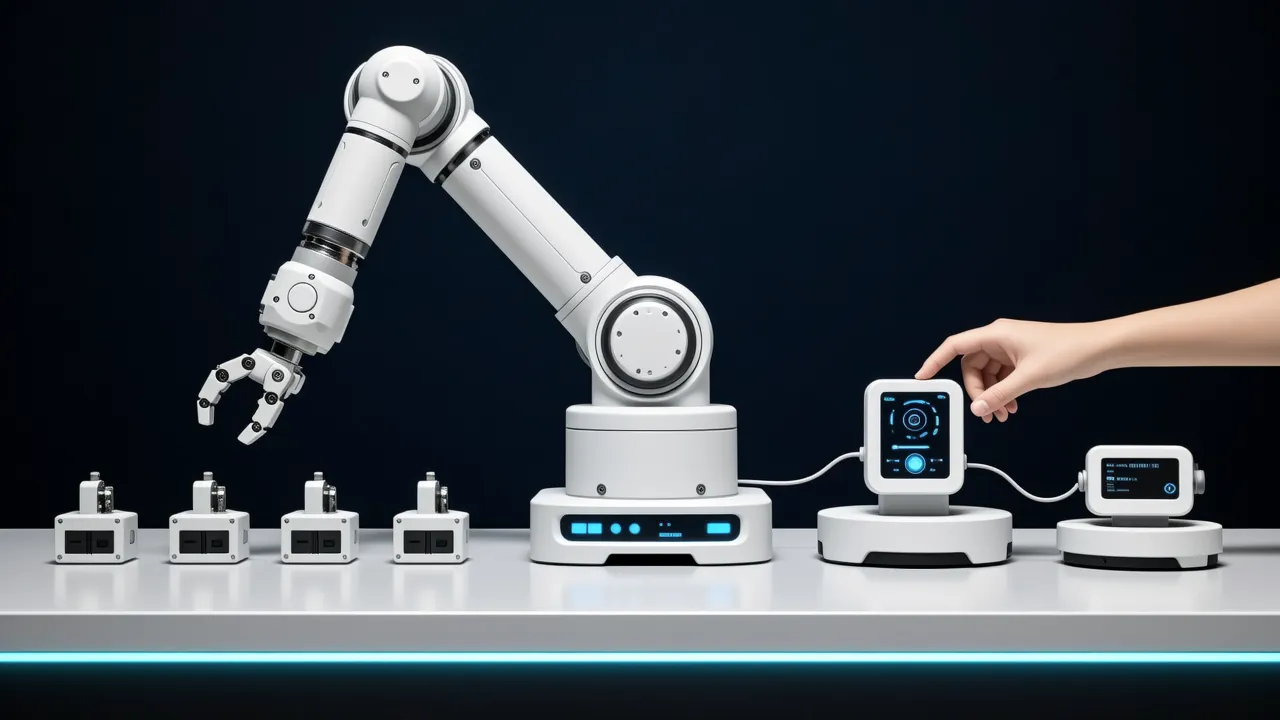
On 13 October 2026 the company announced the beta of the Pi API under the heading "Frontier Models for Every Robot"[1]. The service does three things for a customer: it accepts uploaded data, it fine-tunes models on that data, and it deploys cloud-hosted inference on the customer's own robots[1]. In other words, the model does not have to leave the cloud, and the customer does not have to build a training pipeline or serve the model in-house; the robot on the floor talks to the company's hosted system.
The three steps map onto a common problem in robotics. A team usually has some data from its own machine — demonstrations, teleoperation logs, success and failure runs — but not enough of it, and not the infrastructure, to train a foundation model from scratch. Uploading that data and fine-tuning an existing model is a way to borrow capability rather than build it.
How developers get in
The company's site invites developers to build with the Pi API and to join the waitlist[1]. The waitlist wording fits the beta label: access is being handed out in stages rather than opened to everyone at once, so the first users are likely to be teams already in contact with the company.
Where it sits in the research line
The announcement heads a research list on the company's site that runs back to π0, published on 31 October 2024[1]. Further along that same list sits π0.7, dated 16 April 2026 and described as a steerable robotic foundation model[1]. The API is therefore the commercial layer placed on top of a model line that has been public for roughly two years, from the original π0 through to a version the company calls steerable[1].
Why it matters
Robotic foundation models have mostly been demonstrated in research settings, where the same group controls the robot, the data and the model. An API changes the arrangement: the model becomes a service that other people's hardware can call. That is the step that turns a research result into something a robotics company can build a product on, and it is also the step where the difficult questions move from benchmark scores to operational ones — whose data is uploaded, how fine-tuning changes behaviour, and what happens when inference runs in the cloud and the robot is on a factory floor.
The beta is a limited opening, not a general release. What it establishes is the shape of the offering: data in, fine-tuned model out, inference hosted by the company and delivered to the customer's robots[1].
Sources
- 1Physical IntelligencePhysical Intelligence
Cite this page: Physical Intelligence opens the Pi API beta. TellWorld, https://www.tellworld.net/news/pi-api-2026. Updated 2026-11-08