Background
PixVerse frames its work around a simple claim: video does not have to be a clip rendered in advance. Its earlier model, R1, released in January 2026, was presented as proof that video could be a continuous interactive stream — something generated while it is being watched, and reacting to what the viewer does[1]. A world model in this sense is a system that predicts what a scene looks like next, so that a scene can keep going instead of stopping at a fixed length.
What R2 is
The company published the R2 announcement on 22 September 2026[1]. The framing is deliberate: R2 is described as a scaling release rather than a quality release. The change is not a new benchmark score but more data, more tasks and more input types handled at the same latency[1]. Latency here means the delay between an input and the response on screen; keeping it flat while adding capability is what makes interaction feel continuous rather than like waiting for a render.
Playable worlds
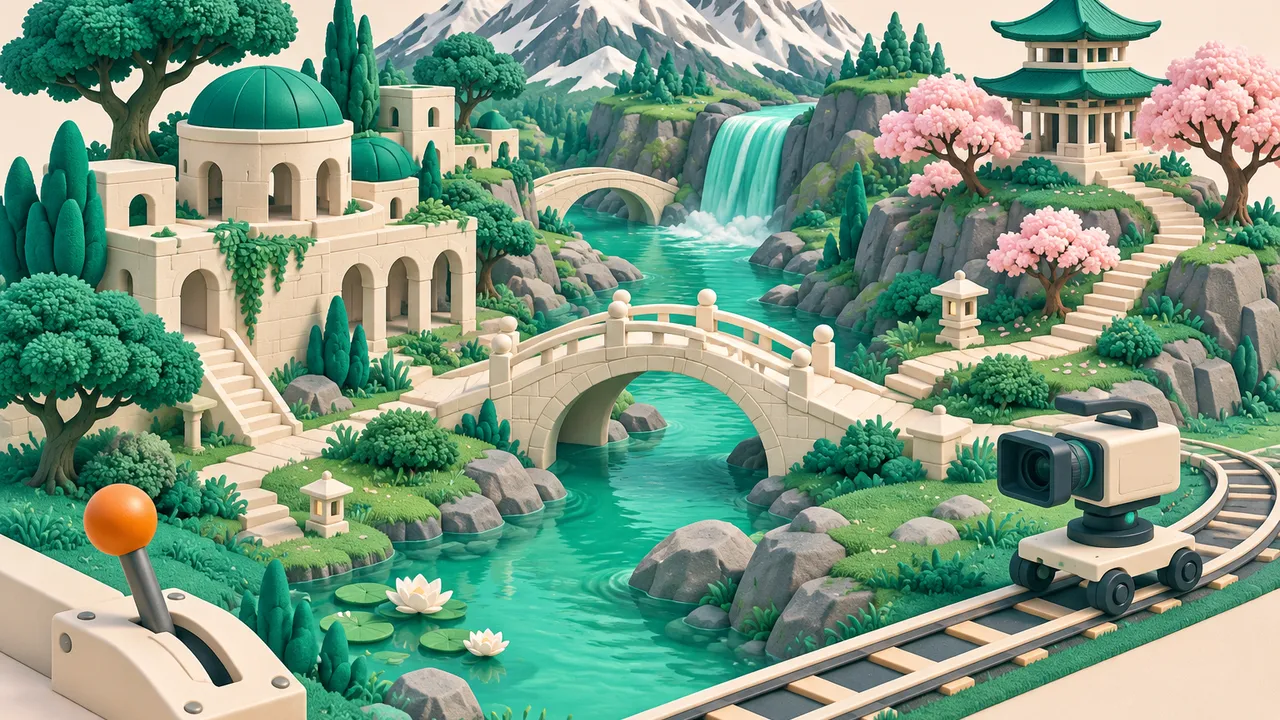
To show what that means in practice, PixVerse published a demo in which a player walks through a generated world using WASD — the standard movement keys of desktop games — and changes that world with text prompts while it is running[1]. Nothing in the scene is pre-built; the world is produced as it is explored and edited.
The announcement also points to work built on top of the model by outside creators. A creator named Xiaolongbao made an interactive film game called Zero Mark on R2. In it, the player is offered a choice — a dragon or a leaf — and the two choices lead to different outcomes generated live rather than picked from a stored branch[1]. That is the interesting shift for narrative design: a fork in the story can be produced at the moment it is taken.
The engine and public access
PixVerse Game Engine, first launched in July 2026, now runs on R2[1]. The company has been talking about the engine in public: head of games Chow Li presented it at the Tech in Asia Conference in September 2026[1], and co-founder and president Jaden Xie spoke on a panel at Google AI App Day in Singapore the same month[1].
The company also opened a set of these worlds to the public at world.pixverse.video, so that people outside the team can walk through and modify them[1].
Why it matters
Interactive generated video has usually been limited by the cost of keeping a scene coherent from frame to frame. PixVerse's argument with R2 is a scaling argument: if the same latency can carry more data, more tasks and more kinds of input, then generated worlds can move from demos toward things people play. The public worlds and the third-party game built on the model are the first places to judge whether that holds up.
Sources
- 1
Cite this page: PixVerse releases R2 and turns its world model into playable games. TellWorld, https://www.tellworld.net/news/pixverse-r2-2026. Updated 2026-11-07