Agility Robotics to go public through a SPAC merger
Agility Robotics announced it will go public through a SPAC merger, raising $465 million as it works to commercialize Digit robots and launch the next-generation Digit 5.
Total 404 · Clear filters
Agility Robotics announced it will go public through a SPAC merger, raising $465 million as it works to commercialize Digit robots and launch the next-generation Digit 5.
On 5 November 2026 Baidu introduced ERNIE 5.5 Flash Base, an open-weight 280B-parameter mixture-of-experts pre-training checkpoint published on Hugging Face under Baidu's own license.
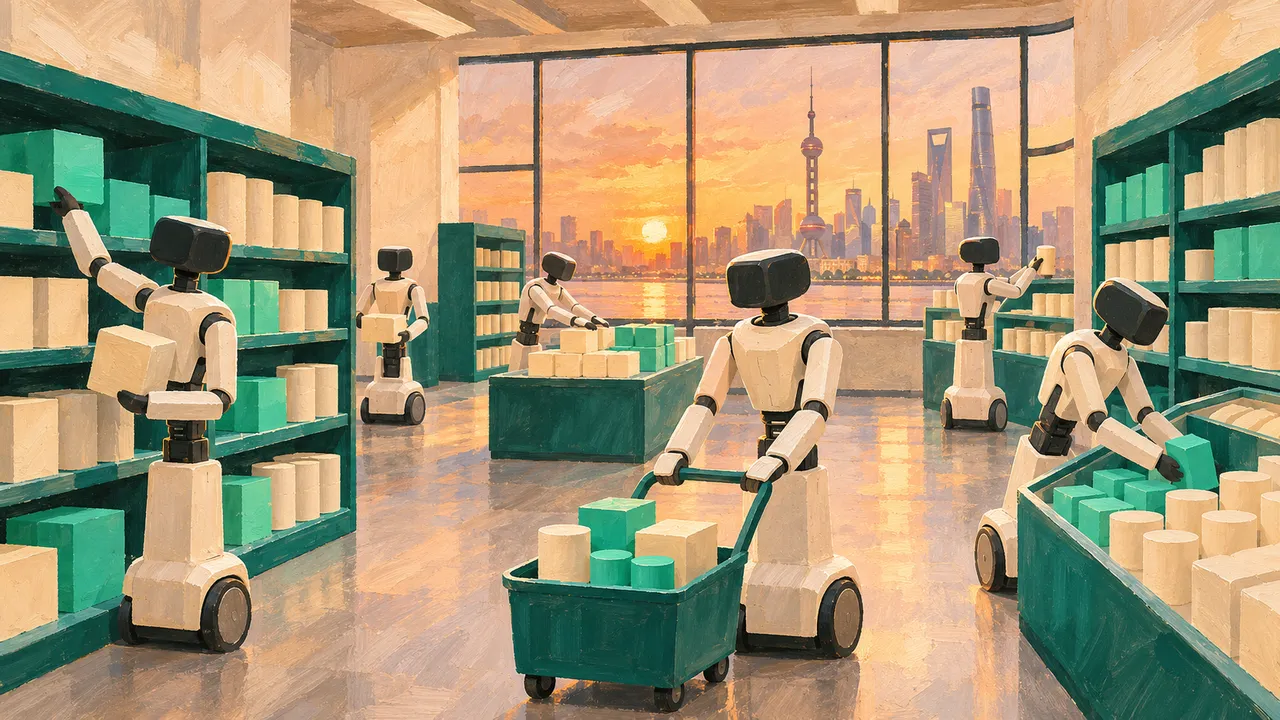
Six AGIBOT G2 wheeled humanoid robots worked a 24-hour shift in an operating Shanghai convenience store, completing 1,730 tasks on a livestream, with four of the six passing the final assessment.
AGIBOT's Innovation Day 2026 in Shanghai on 29 October 2026 introduced the Worken output metric, the AHA3 humanoid hardware architecture, the G2 Max industrial robot, Link-U OS 1.0, the GO-3 Preview and the WITA-Omni interaction model.
On 28 October 2026 Nvidia released Nemotron 3.5 Transcribe, an open-weight, free speech recognition model covering up to 40 languages, alongside the second version of its Granary speech dataset.
On 26 October 2026 PFN released the weights of PLaMo 3 Translate, a 53-language translation model built on a base model from joint research with NICT, in four sizes from 0.8B to 31B and several quantised formats.
The Agentic AI Foundation reported 305 member organisations in under a year, saying agents are moving from developer experiments to institutional infrastructure.
On 22 October 2026 the Agentic AI Foundation added four projects — Agent Skills from Anthropic, Open Responses from OpenAI, OpenEnv from Hugging Face and OpenSandbox from Alibaba — bringing it to 10 hosted projects covering different layers of the agentic stack.
On 22 October 2026 Anthropic handed the Agent Skills open standard — its name, logo, GitHub organisation and domain — to the Agentic AI Foundation, a Linux Foundation project, after more than 70 agent platforms had adopted it.
On 21 October 2026 Liquid AI released LFM3-Omni-2B, the first omni-modal model in its LFM3 family, taking text, images, video and audio as input and returning text or speech. At 2.17B parameters it targets phones and laptops.
On 17 October 2026 DeepSeek shipped DeepSeek-V4.1-Flash-1017, an update to its smallest model with better benchmarks, faster task completion and shorter outputs; its weights were published and its Search and Fetch APIs opened at $0.75 per 1,000 calls.
On 15 October 2026, IFM and Inception42 announced Jais 3, six Arabic-centric language models from 900 million to 375 billion parameters plus a speech recogniser, evaluated on 24 audited Arabic benchmarks.
On 15 October 2026 Meta released Muse Spark Open, an open-weight, natively multimodal model with 816 billion total parameters, optimised to run on Apple's Mac Studio. Its weights were published on Hugging Face.
On 13 October 2026, Physical Intelligence opened a beta of the Pi API, a service that lets customers upload their own robot data, fine-tune the company's models and run cloud-hosted inference on their own machines.
On 6 October 2026 Mistral AI opened a public preview of Mistral Large 4, a model with about 1 trillion total parameters. On 29 October 2026 it released open weights of an improved version.
On 3 October 2026 Aleph Alpha released Kolibri, an open-weight model pitched at public administration, industry and aerospace, with German-language specialization and a traceable training process presented as its advantage rather than raw scale .
Waymo said it will launch its autonomous ride service in Toronto, its first Canadian city, with the first passengers planned for 2028.
MiniMax posted the weights of M3.1-Flash to Hugging Face on 17 October 2026. The model is a multimodal M3-line release with about 428 billion parameters, MiniMax Sparse Attention throughout, and DSpark speculative decoding.
In October 2026 Moonshot AI released Kimi K3.1 Pro, an open-weights upgrade for financial research, 3D modeling and coding. It was the first model in the K3.1 series.
Character.ai's CAI-Image family consists of image models post-trained from open-source Qwen-Image and tuned for character-driven storytelling, so the same character stays recognisable across styles, scenes and pages. The company announced the models on 16 September 2026.
On 10 September 2026 DeepSeek released DeepSeek-V4.1-Flash, a multimodal model with a causal encoder-decoder design that splits its active parameters between reading input and writing output. Its KV cache is much smaller than that of the previous generation.