Roomba is a home robot vacuum that iRobot unveiled in September 2002 [1]. The Chinese business outlet 21世纪经济报道 also dates the company's first home robot vacuum to 2002 [2], and credits the launch with creating the consumer robot vacuum category [2].
Background
Before Roomba, iRobot's founding team had spent the preceding years working on defence and space robotics [2]. Those are institutional customers: a small number of units, built to order, delivered through contracts rather than shop shelves. Roomba was the company's first mass-market hit [2].
That shift changes what the machine has to be. A robot sold to a defence agency or a space programme can be expensive, delicate and operated by trained staff, because the buyer cares about whether it completes the task. A robot sold to households has to be cheap enough that an ordinary family will buy it, sturdy enough to survive being knocked around, and simple enough that nobody needs to read a manual. That is roughly what the phrase "consumer category" means: not the highest specifications, but a product ordinary households are willing and able to pay for.
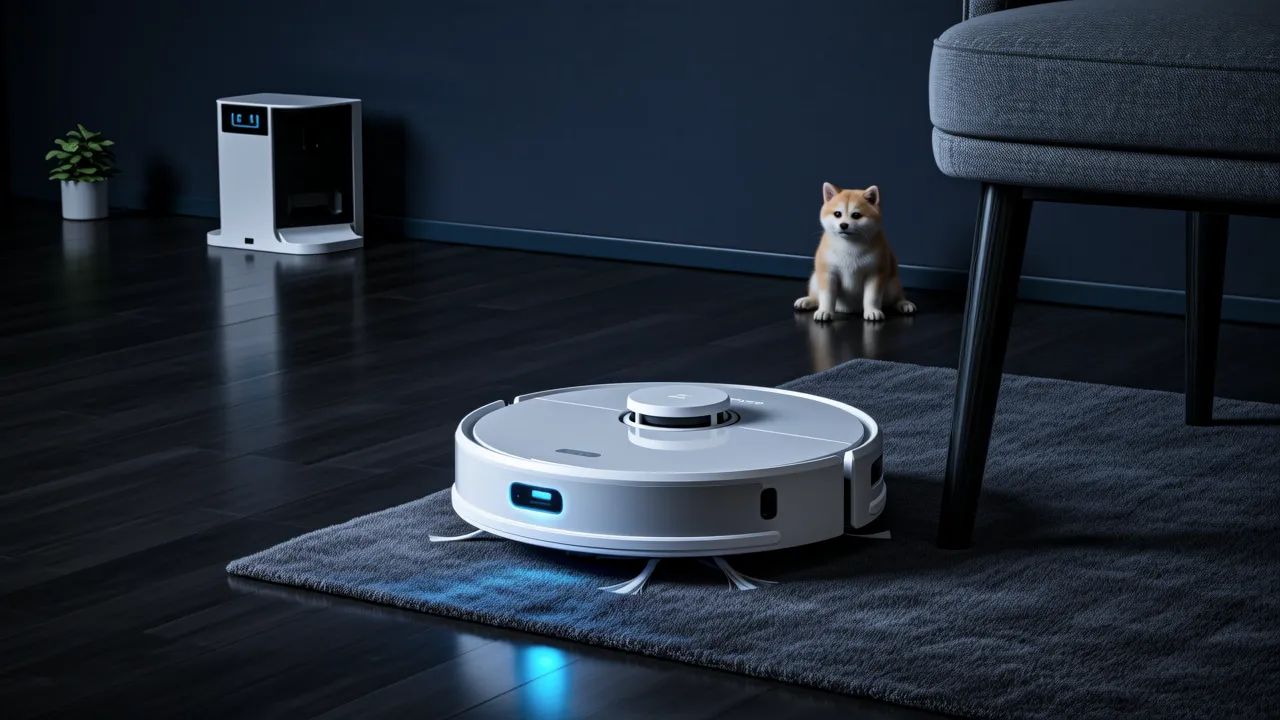
A robot vacuum, in the general sense, is a flat, disc-shaped machine that drives itself across a floor, senses walls and obstacles, and collects dust and debris in an onboard bin. Making such a device work is one problem; making one cheap and reliable enough to sit in a living room is another.
The launch
iRobot unveiled Roomba in September 2002 [1]. 21世纪经济报道 records the same year for the company's first home robot vacuum [2]. That account gives the launch credit for creating the consumer robot vacuum category — for turning a direction that had belonged to research and industry into a class of product sold to ordinary households [2].
Sales
The first year's sales were 50,000 units [2]. After that the figures grow quickly, though the sources differ. Wikipedia says Roomba had sold a million units by 2004 [1]. 21世纪经济报道 says cumulative sales passed two million units by 2005 [2]. The two records agree on neither the date nor the count, so a citation is clearer when it says which account the number comes from.
What the numbers do establish is scale: tens of thousands of units in the launch year, and millions cumulatively within a few years [1][2]. Selling consumer hardware at that volume requires manufacturing lines, packaging, retail distribution and after-sales support — capabilities quite different from delivering a handful of custom robots to an agency.
Going public
In 2005, three years after the launch, iRobot listed on NASDAQ [2]. A listing takes a company to the public markets: it raises money by selling shares to outside investors, and in exchange it takes on the obligation to report its business regularly to the public. For a company that had grown up on contract work, that is a different kind of institution.
Why it matters
Roomba matters on three levels, each of which follows from what the sources record rather than from anything about how well the machine cleaned.
For the product category, it is remembered as the starting point of the consumer robot vacuum [2]. Before it, the company at the centre of the story had put its effort into defence and space robotics [2]; after it, a household cleaning robot was a category with identifiable buyers.
For the company, Roomba was the first mass-market product [2], which carried an outfit built around institutional and space work onto retail shelves, where success is measured in units sold to individual families rather than in contracts completed.
For anyone watching the field, the sequence is the instructive part: a launch, 50,000 units in the first year, millions of units within a few years, and a stock listing three years on [2]. It is one worked example of how robotics reaches households — not by waiting until a general-purpose machine is ready, but by picking one concrete chore and making a product cheap enough to sell in quantity.
Sources
- 1iRobotWikipedia
- 2从登上火星到被「反向接管」,iRobot何以被挤下牌桌?21世纪经济报道 / 南方+
Cite this page: iRobot launches Roomba. TellWorld, https://www.tellworld.net/news/roomba-2002. Updated 2026-11-07