Background
CyberDog arrived at a moment when several large technology companies were putting money and engineering effort into bionic robots, a category that draws interest both as a research platform and as a possible consumer device [1]. Xiaomi, a company known mainly for smartphones and connected home products, used its autumn launch event to show a four-legged machine rather than a phone.
What was announced
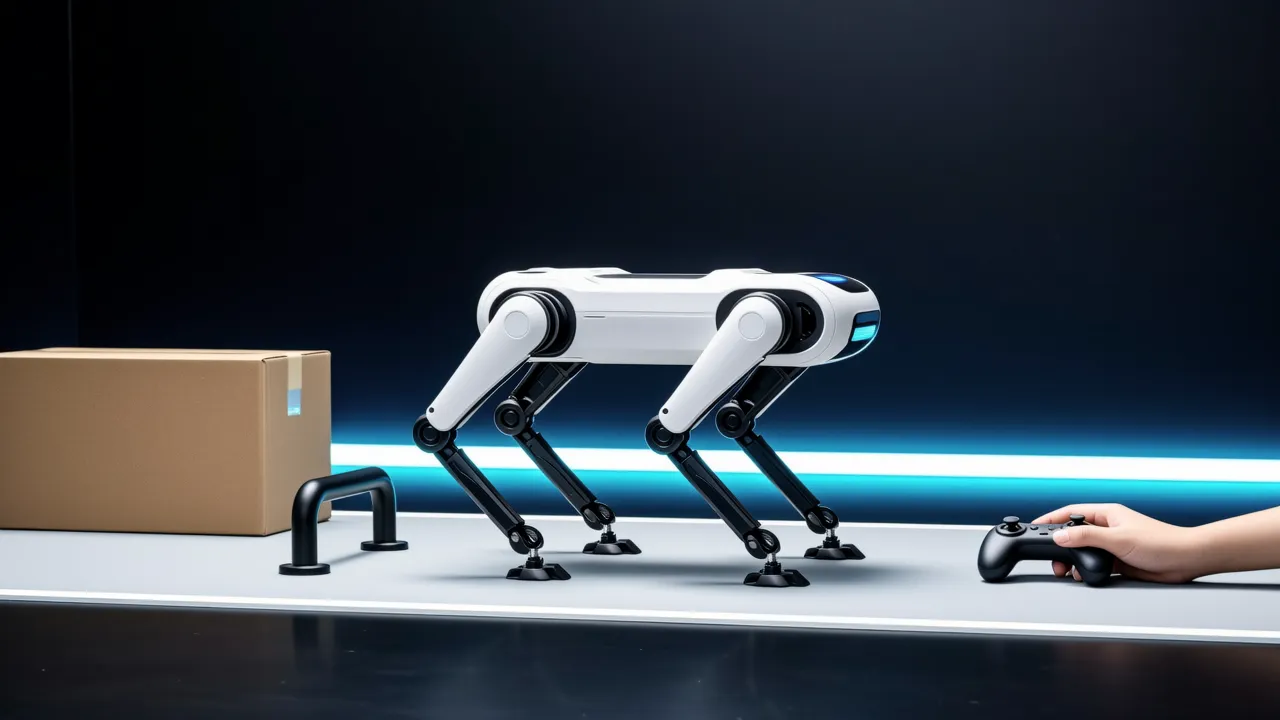
On the evening of 10 August 2021, at that autumn product launch, Xiaomi unveiled CyberDog, a bionic quadruped robot that the company nicknamed Tiedan [1]. It was presented as an "engineering exploration edition", a version aimed at people who want to build on the hardware rather than at a finished consumer product [1].
Specifications
According to China News Service, the robot weighs 14 kg and reaches a top running speed of 3.2 m/s [1]. Its computing comes from NVIDIA's Jetson Xavier NX platform, which provides 21 TOPS of AI computing power, paired with an AI vision system that supports autonomous following and obstacle avoidance [1].
The same report describes a fairly wide movement repertoire: the robot can jump, run, roll, shake hands, spin and perform a backflip, and it can recover its balance when pushed [1]. That last behaviour matters for a legged machine, because staying upright after a shove is the basic test of whether a robot can walk around people and furniture without falling over.
Xiaomi's own product page lists 11 high-precision sensors used for perceiving the environment [2]. Sensors are the input side of the vision and balance systems: cameras, inertial measurement and ranging devices feed the onboard computer, which then decides how to move each leg.
Two different speed numbers
The published figures do not agree, and the difference is worth noting. Xiaomi's official page gives the robot's maximum safe walking speed as 1.6 m/s, half the 3.2 m/s laboratory figure reported in coverage of the launch [2][1]. The two describe different things: a top speed measured under test conditions, and a speed the maker considers safe for ordinary operation. Buyers therefore get a machine rated at 1.6 m/s, even though its hardware has been demonstrated running faster.
Price, availability and testers
Xiaomi priced the engineering exploration edition at 9,999 yuan and limited it to 1,000 units worldwide [1]. Alongside the sale, the company opened a beta programme: 400 users would join the first testing round, with the list of participants due to be announced at 14:00 on 8 September [1].
What it represented
The notable part of the launch was not any single specification but the packaging. A quadruped robot with an AI computer, a vision system and a dozen sensors was offered at a stated price, in a stated quantity, to anyone who wanted one, plus a structured beta round for early users [1][2]. Legged robots had largely been laboratory and research instruments; CyberDog was presented as something an individual developer or hobbyist could buy, take apart and program. The 1,000-unit limit and the 400 beta places also set expectations for how many machines would be in outside hands at the start.
For Xiaomi, the robot extended a product line that had been built on phones and home devices into machines that move through a room on their own [1]. For the wider field, it was a data point on how quickly quadruped hardware, once confined to well-funded labs, was being pushed toward individual buyers — with the gap between laboratory performance and rated safe operation, visible in the company's own numbers, as a reminder of how much work sits between a demonstration and a product [2].
Sources
- 1
- 2CyberDog 工程探索版Xiaomi
Cite this page: Xiaomi unveils CyberDog. TellWorld, https://www.tellworld.net/news/cyberdog-2021. Updated 2026-11-08