Background
Getting a humanoid robot to walk across a stage is one problem; getting thousands of them off a production line is another. The second problem is mostly about manufacturing: which processes a part is made with, how many suppliers a design depends on, and how much each unit costs to build. Figure's announcement of its third-generation machine was framed largely in those terms.
What was announced
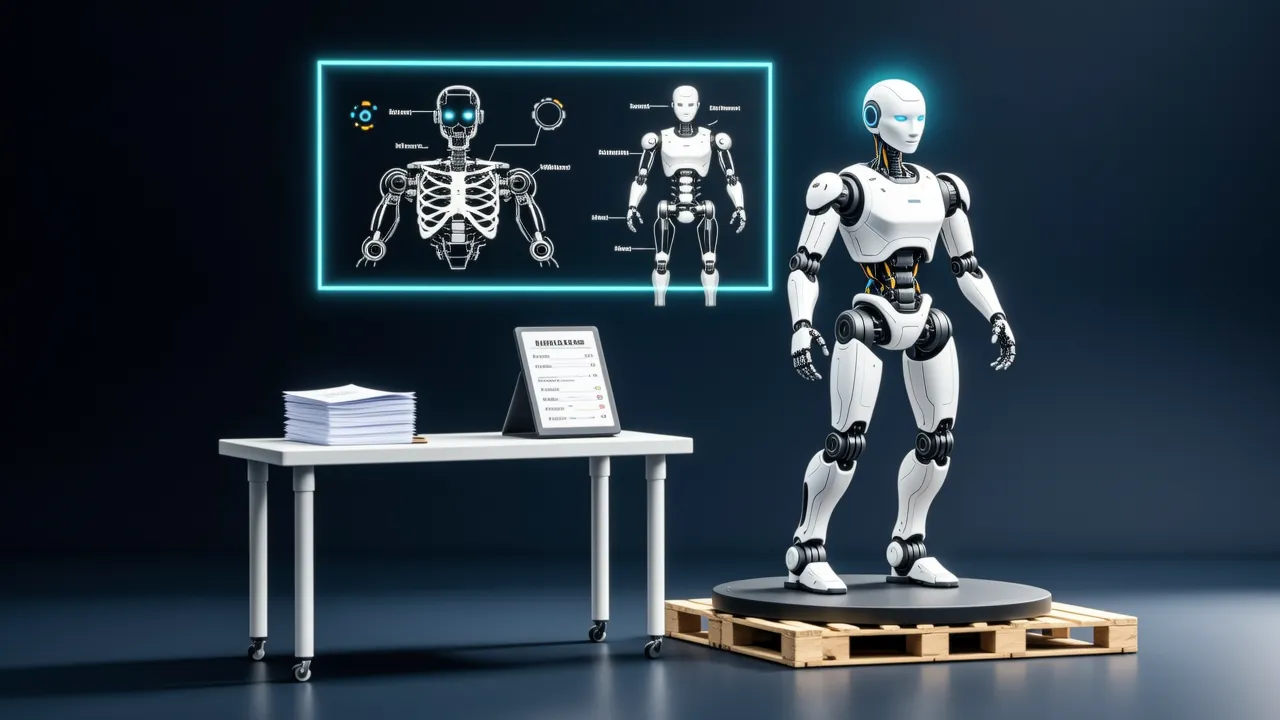
Figure introduced Figure 03, its third-generation humanoid robot, on 9 October 2025 [1]. The company said the robot was designed for Helix, for the home, and for the world at scale — that is, the design targets were not only a research or factory setting but also domestic use and large-scale deployment [1].
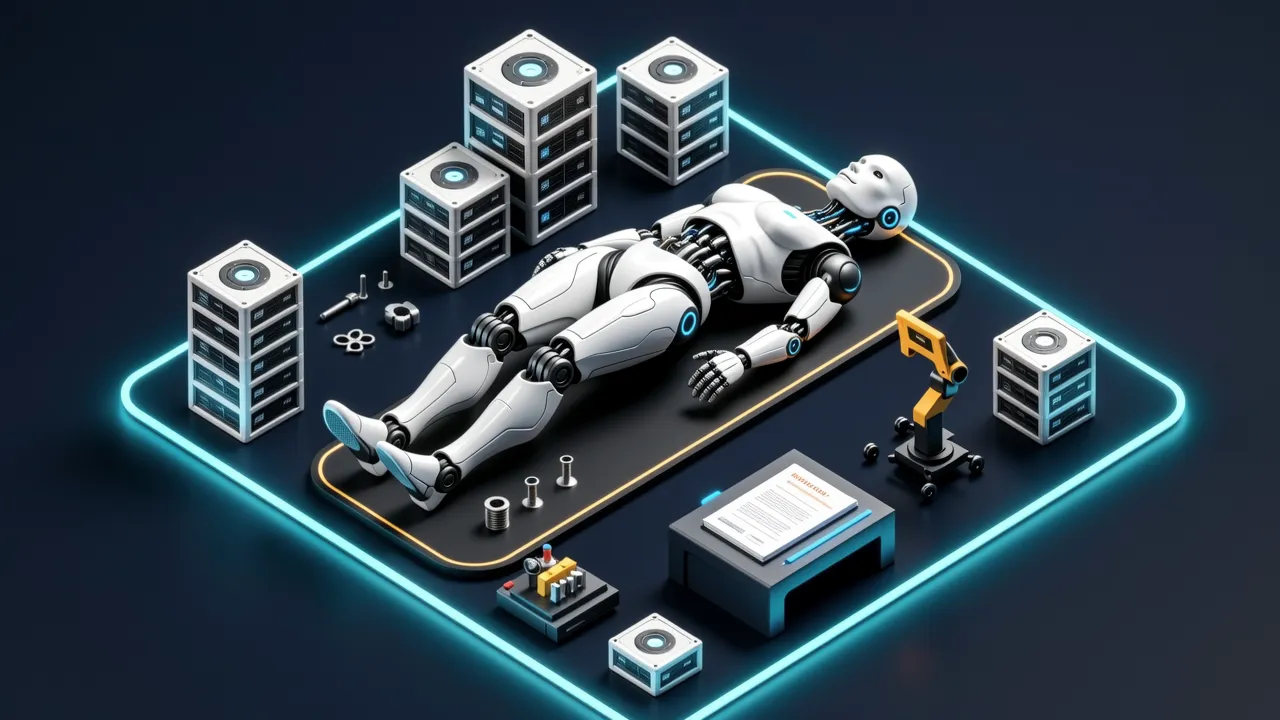
According to Figure, the programme involved a ground-up redesign of both hardware and software, together with an entirely new supply chain and a new manufacturing process established at BotQ [1].
From machined parts to tooled parts
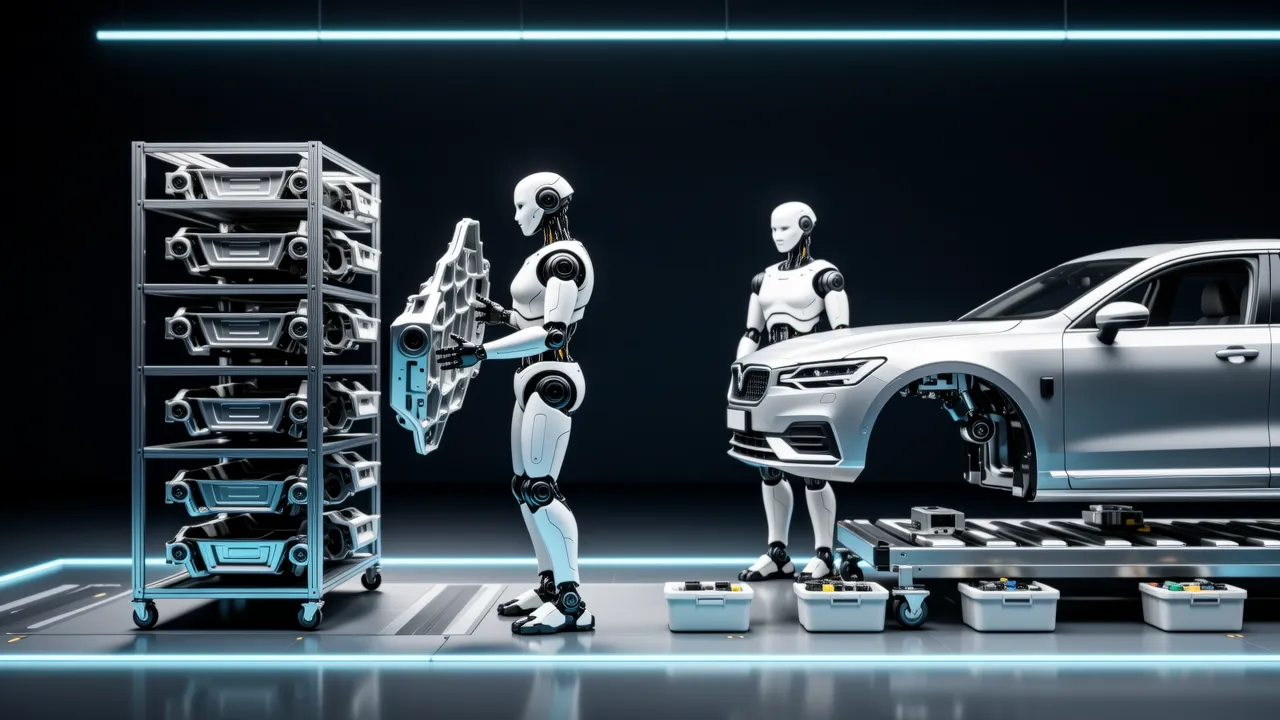
The clearest way to see the shift is in how parts are made. Figure said Figure 02 was primarily designed for CNC machining, in which material is cut away from a block to produce a part [1]. Figure 03 instead relies on tooled processes — die-casting, injection molding and stamping [1]. These are methods in which a shaped tool forms material rather than cutting it out, and they are the standard way to make parts cheaply in volume once the tooling exists. The consequence, in Figure's account, is that each Figure 03 unit now costs dramatically less to build [1].
Sensing, power and data
Several of the published details concern the robot's sensing and energy systems. Figure said the new vision system delivers twice the frame rate, one-quarter the latency, and a 60% wider field of view per camera [1]. Higher frame rate and lower latency matter for control: the sooner an image reaches the software, the sooner the robot can react to what it sees.
Figure said the fingertip sensors can detect forces as small as three grams [1]. That figure describes sensitivity at the low end — the ability to register a light touch rather than a firm grasp.
On power, Figure said the battery is certified to UN38.3, the United Nations standard for the safe transport of lithium batteries [1]. It also said charging coils built into the robot's feet allow 2 kW wireless inductive charging, in which power transfers across a gap without a plug, and that the robot supports 10 Gbps mmWave data offload — high-bandwidth wireless transfer of data rather than a physical connection [1].
Production plans
Figure said the first-generation line at BotQ can produce up to 12,000 robots per year, with a goal of 100,000 robots over four years [1]. Reaching the four-year goal would require output well above the stated annual capacity of that first line, which points to further lines or expansion beyond the initial figure.
Why it matters
The announcement says relatively little about what the robot can do and a great deal about how it is made. That emphasis reflects a stage in which humanoid robots are judged on whether they can be produced in quantity at a workable cost, not only on whether a demonstration works once. Cost per unit, supply chain depth and line capacity are the numbers that decide whether a robot reaches homes and workplaces at all. Figure 03 is presented as a step in that direction, with a design aimed at domestic use and volume production rather than at a single showcase task [1].
Sources
- 1Introducing Figure 03Figure AI
Cite this page: Figure introduces Figure 03. TellWorld, https://www.tellworld.net/news/figure-03-2025. Updated 2026-11-08