The announcement
On 4 February 2025, Brett Adcock announced that Figure would terminate its collaboration agreement with OpenAI [1][2]. The news came only a few days after he had announced Figure's second commercial customer, described as one of the largest US companies [1][2]. The timing linked two subjects: customer traction and the question of who would build the robot's intelligence. For Figure, the termination was therefore not just a contract change; it was a public statement about how the company intended to develop embodied AI.
Why the collaboration ended
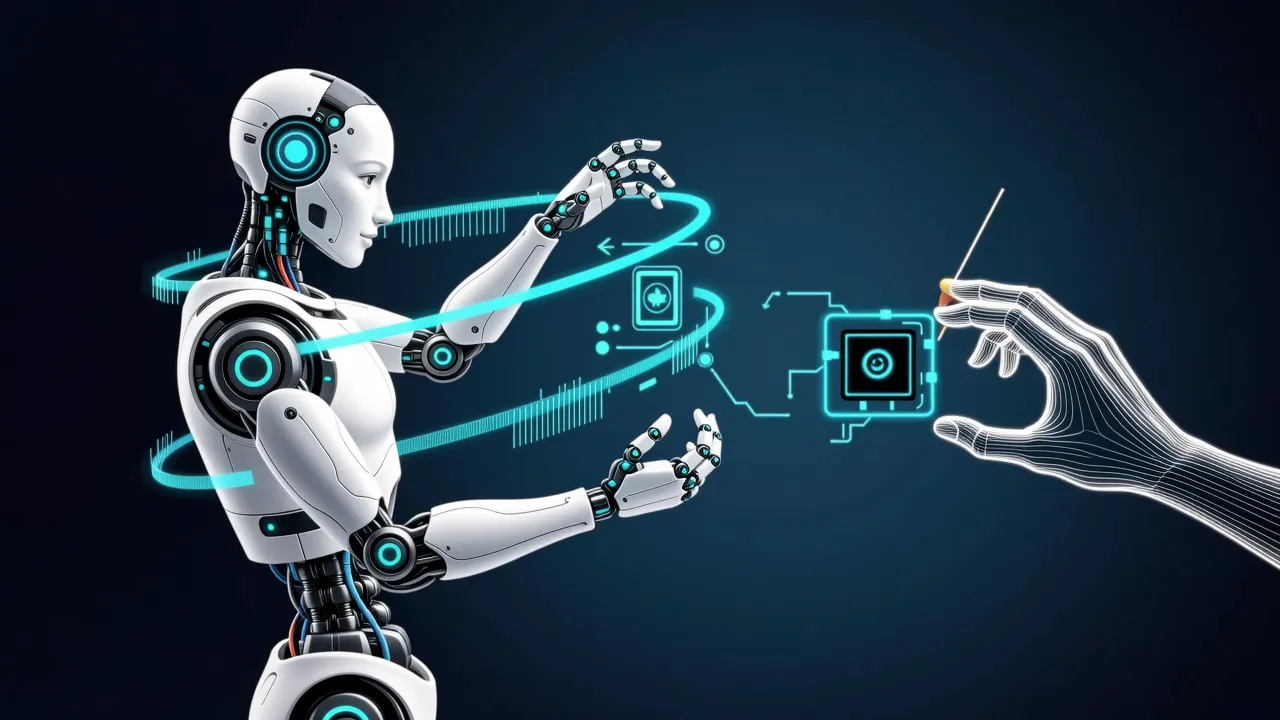
Adcock told TechCrunch that the key problem was integration, because embodied AI was not a core focus for OpenAI [1]. Embodied AI refers to AI that perceives and acts through a physical body rather than only processing text or images. On a humanoid robot, integration means joining sensor input, scene understanding, motion planning and joint control into a loop that can run in real time. If one link is weak, the robot struggles with continuous tasks. By naming integration, Adcock pointed away from a single model and toward the whole system.
He also said Figure had made a major breakthrough on fully end-to-end robot AI built entirely in-house, and that the company would show something never before seen on a humanoid within 30 days [1]. In robotics, end-to-end generally describes a system that maps inputs such as camera images and sensor readings directly to actions, instead of passing information through a chain of separately engineered modules. That approach puts more weight on data and training and requires tight coupling between software and hardware. Figure's claim was therefore technical and organizational: the core AI was to be developed inside the company, not through the OpenAI collaboration [1].
The commercial backdrop
The split did not arrive without commercial news. Adcock said that with BMW, Figure already had a fleet of robots performing end-to-end operations [2]. A real-world deployment is a test of integration because the robot has to keep working in a real environment, not only in a demonstration. He also said shipments to Figure's two customers, BMW and the new client, could reach 100,000 humanoid robots over the following four years [1]. That was a potential shipment volume tied to two customers, while the BMW fleet described a current operation. The two numbers are not the same measure: one concerns robots already running, the other a possible future scale. Both depend on the same question of whether the integrated system can be repeated and delivered.
What it signals
For Figure, the episode separated two kinds of dependence: commercial validation from large customers and technical dependence on an external AI partner. By saying the robot AI would be built entirely in-house, Adcock placed the core intelligence inside the company [1]. The stated reason — that embodied AI was not a core focus for OpenAI — also points to a difference in priorities between general AI labs and robotics companies [1]. Partnerships can bring resources and models, but a robotics firm may decide that the control stack for a physical machine has to be owned and integrated in-house.
In humanoid robotics, a demo can show a capability, but a deployed fleet has to combine models, hardware, safety and operations. Integration is where those pieces meet. Figure's announcement therefore set a public test: deliver the in-house end-to-end system it promised, and turn its work with BMW and the second large customer into actual shipments [1][2]. The significance of the split lies less in the contract itself than in the standard Figure set for itself — whether an end-to-end system can run on real robots and whether customer projects can move toward scale.
Sources
- 1Figure終止與OpenAI合作、將發表人形機器人重大創新MoneyDJ 理財網
- 2
Cite this page: Figure ends its collaboration with OpenAI. TellWorld, https://www.tellworld.net/news/figure-openai-end-2025. Updated 2026-11-08