The Agentic AI Foundation passes 300 members in under a year
The Agentic AI Foundation reported 305 member organisations in under a year, saying agents are moving from developer experiments to institutional infrastructure.
Total 19 · Clear filters
The Agentic AI Foundation reported 305 member organisations in under a year, saying agents are moving from developer experiments to institutional infrastructure.
On 22 October 2026 the Agentic AI Foundation added four projects — Agent Skills from Anthropic, Open Responses from OpenAI, OpenEnv from Hugging Face and OpenSandbox from Alibaba — bringing it to 10 hosted projects covering different layers of the agentic stack.
On 11 December 2025, Runway announced GWM-1, a general world model that simulates environments in real time, released in Worlds, Avatars and Robotics variants and built on the company's Gen-4.5 model.
On 16 October 2025 Anthropic introduced Agent Skills, folders of instructions, scripts and resources that Claude loads when a task calls for them. On 18 December 2025 the format was published as an open standard.
On 5 August 2025 Google DeepMind announced Genie 3, a world model that turns text into navigable environments generated in real time at 24 frames per second and 720p, released as a limited research preview.
On 29 July 2025 the Linux Foundation welcomed AGNTCY, an open project for interoperable AI agents, with Cisco, Dell Technologies, Google Cloud, Oracle and Red Hat as formative members.
On 26 July 2025 Tencent open-sourced HunyuanWorld 1.0, a model that builds explorable 3D worlds from text or images, with a technical report.
On 9 April 2025 Google announced Agent2Agent (A2A), an open protocol that lets AI agents from different vendors communicate, exchange information securely and coordinate work. In June 2025 the Linux Foundation said it would host the project.
On 4 April 2025 GitHub released Copilot agent mode and MCP support to all VS Code users, letting the assistant take actions, propose commands and call external tools, with a 56.0% pass rate reported on SWE-bench Verified.
On 18 March 2025 NVIDIA announced Isaac GR00T N1, a humanoid robot foundation model released immediately to robotics developers as the first of a family of customizable pretrained models, alongside open simulation tools.
On 6 January 2025, at CES, NVIDIA launched Cosmos, a platform of open world foundation models for physical AI used to train robots and autonomous vehicles.
Genie 2 is a Google DeepMind world model, announced on 4 December 2024, that turns a single image into a playable, action-controllable 3D world that people or AI agents can explore with a keyboard and mouse.
On 25 November 2024 Anthropic open-sourced the Model Context Protocol, a standard for connecting AI assistants to the systems where data lives. In December 2025 Anthropic donated it to the Agentic AI Foundation under the Linux Foundation.
In March 2024 NVIDIA announced Project GR00T, a general-purpose foundation model for humanoid robots. A year later it released Isaac GR00T N1, which it presented as a fully customizable humanoid model.
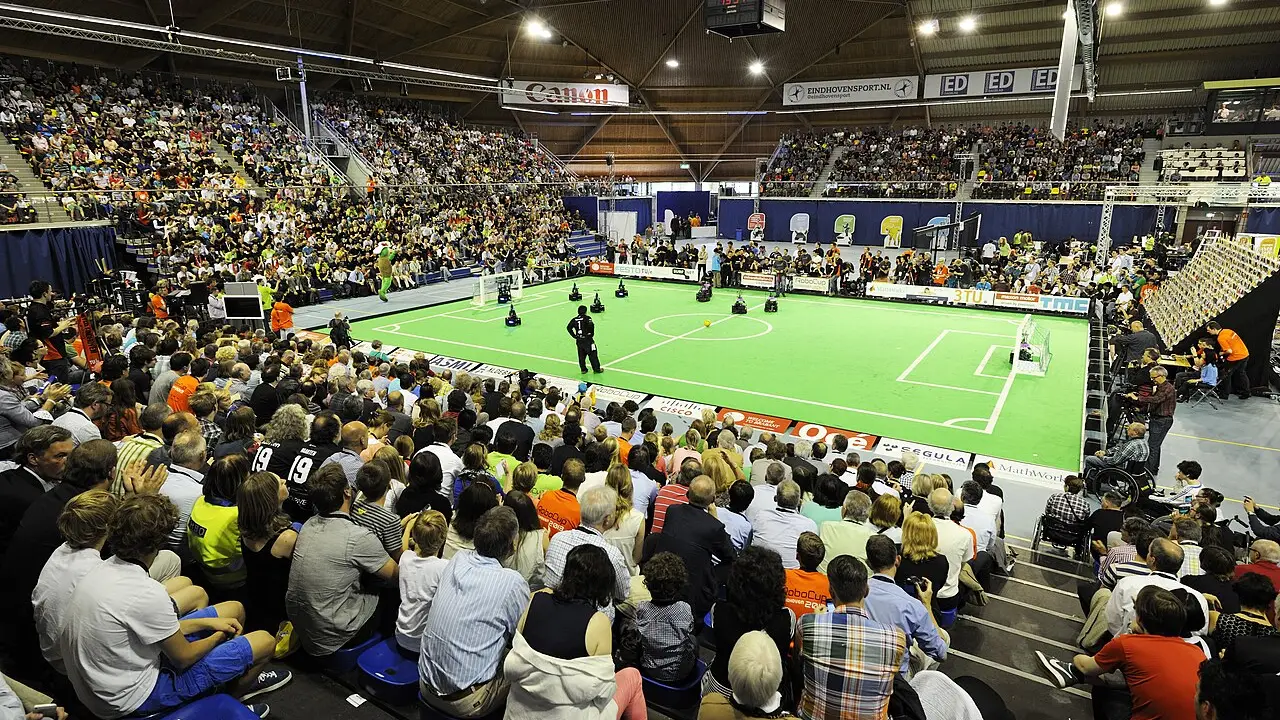
The first official RoboCup games and conference, held in 1997 as planned with IJCAI-97 in Nagoya, drew more than 40 real and simulated teams and over 5,000 spectators, and marked the first step toward robotic soccer players that could beat a human World Cup champion team.
Held in Osaka in November 1996 alongside IROS-96, Pre-RoboCup-96 was the first robot soccer competition aimed at research and education, with eight simulation-league teams and a middle-size robot demonstration; official RoboCup games followed in 1997.
At IJCAI-95 in Montreal in August 1995, organizers announced the first Robot World Cup, to be held with IJCAI-97 in Nagoya, and set up Pre-RoboCup-96 plus the Soccer Server simulator.
In June 1993, researchers including Minoru Asada, Yasuo Kuniyoshi and Hiroaki Kitano proposed a robot soccer competition tentatively called the Robot J-League. International interest soon led to its renaming as the Robot World Cup Initiative, or RoboCup.
In 1992, Alan Mackworth's paper on seeing robots and a Tokyo workshop on AI grand challenges independently put forward robot soccer as a way to drive AI and robotics research.