Unitree launches Go1
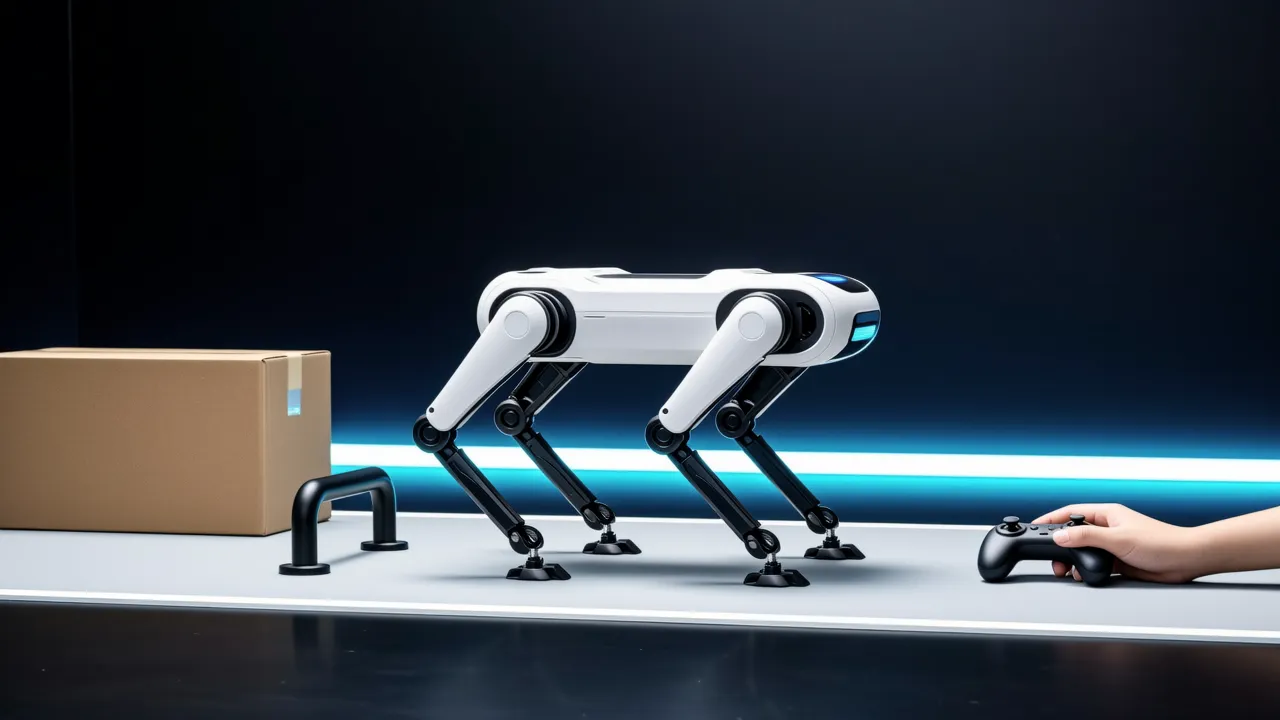
In June 2021 Unitree released the Go1, a consumer quadruped robot priced from 16,000 yuan, weighing 12 kg and running at up to 4.7 metres per second; it sold nearly 1,000 units in its first year.
Total 1,098
In June 2021 Unitree released the Go1, a consumer quadruped robot priced from 16,000 yuan, weighing 12 kg and running at up to 4.7 metres per second; it sold nearly 1,000 units in its first year.
GPT-J-6B is a six-billion-parameter language model released by EleutherAI in June 2021 with open weights under Apache 2.0, trained on The Pile and reported to be close to the 6.7B GPT-3 on zero-shot tasks.
On 18 May 2021 Google announced LaMDA, a language model built for conversation, at its I/O keynote. It grew out of the Meena chatbot, was followed by LaMDA 2 and the AI Test Kitchen, and later powered Bard.
In April 2021 the European Commission put forward its proposal for an Artificial Intelligence Act, submitted by Internal Market Commissioner Thierry Breton. It opened a negotiation in which the Council of the EU adopted its own position in December 2022.
On 29 March 2021 Boston Dynamics announced Stretch, a mobile robot aimed at warehouse work such as truck unloading, built on a small omni-directional base so warehouses can adopt it without costly fixed automation infrastructure.
On 21 March 2021 EleutherAI released GPT-Neo, a family of language models at 125M, 1.3B and 2.7B parameters whose weights anyone could download, in contrast to OpenAI's API-only GPT-3.
On 5 January 2021 OpenAI announced DALL·E, a neural network that creates images from text captions, and CLIP, which learns visual concepts from natural-language supervision.
Anthropic, an AI company, was incorporated in January 2021 by former employees of OpenAI and set up as a public benefit corporation. Dario Amodei became its chief executive and Daniela Amodei its president.
On 31 December 2020 EleutherAI released The Pile, an openly available 825 GiB English training corpus assembled from 22 smaller datasets, with a paper showing models trained on it beat both comparison corpora on every component.
On 7 December 2020, Aurora announced it was acquiring Uber's self-driving unit, the Advanced Technologies Group, with Uber investing 400 million dollars in Aurora and its chief executive joining Aurora's board.
On 30 November 2020 DeepMind announced that the organisers of CASP14 had recognised its AlphaFold system as a solution to the 50-year-old protein-folding problem, with accuracy approaching that of experimental methods.
On 13 September 2020, NVIDIA agreed to buy Arm Limited from SoftBank and the SoftBank Vision Fund for $40 billion in shares and cash, with Arm to keep its open-licensing model and Cambridge headquarters, subject to regulatory approval.
In June 2020 OpenAI announced an API that let outside developers access its AI models. By March 2021 more than 300 applications were using GPT-3 through it.
In May 2020 OpenAI published the GPT-3 paper, describing a 175-billion-parameter language model that performs new tasks from a few examples given in its text input, without additional training.
On 14 May 2020 NVIDIA announced the A100, its first GPU built on the Ampere architecture, claiming up to 20 times the AI performance of its predecessors. It shipped in full production alongside new systems, cloud partners and supercomputer customers.
The European Commission's February 2020 white paper set out a policy to promote the uptake of AI while limiting the risks of certain uses, built on a risk-based approach, an ecosystem of excellence and an ecosystem of trust.
On 27 January 2020, Google researchers posted a paper describing Meena, a 2.6-billion-parameter open-domain chatbot that scored 79% on a new chat-quality metric called the Sensibleness and Specificity Average.
On 14 January 2020, Keya Medical's Shenmai FFR software became the first AI medical device to receive a class III certificate in China, opening a registration path for diagnostic software and later reaching billable clinical use.
On 19 November 2019, DeepMind posted a MuZero preprint to arXiv: it plans with a learned model rather than rules, matched AlphaZero in Go, chess and shogi, and set a state of the art on 57 Atari games.
On 5 November 2019 OpenAI released the full 1.5-billion-parameter GPT-2, with code and model weights, ending its staged release. The model card warned that the model cannot tell fact from fiction.
On 30 October 2019, DeepMind announced that AlphaStar reached Grandmaster level in StarCraft II for all three races, ranking above 99.8% of active players and playing under human-like interface limits.