Moonshot AI releases Kimi K2.6 for long-horizon coding
In April 2026 Moonshot AI released Kimi K2.6, an open-weight model aimed at long-horizon coding, with Agent Swarm scaled to 300 sub-agents and 4,000 coordinated steps.
Total 290 · Clear filters
In April 2026 Moonshot AI released Kimi K2.6, an open-weight model aimed at long-horizon coding, with Agent Swarm scaled to 300 sub-agents and 4,000 coordinated steps.
On 11 March 2026 Reka released Reka Edge, a 7-billion-parameter vision-language model built for physical AI on devices rather than in the cloud, with a 3.5-bit quantization format and comparisons against Qwen3.5 9B, Cosmos Reason2 8B and Gemini 3 Pro.
In March 2026 MiniMax released MiniMax-M2.7, a model with 229B listed parameters that the company described as its first to take part in its own evolution, and which posted strong scores on machine-learning, coding, science and competition-math benchmarks.
In early 2026 OpenAI assembled a private funding round that grew from $110 billion to $122 billion in committed capital, closing on 31 March 2026 at an $852 billion post-money valuation, with Amazon, SoftBank, Nvidia and Microsoft among the backers.
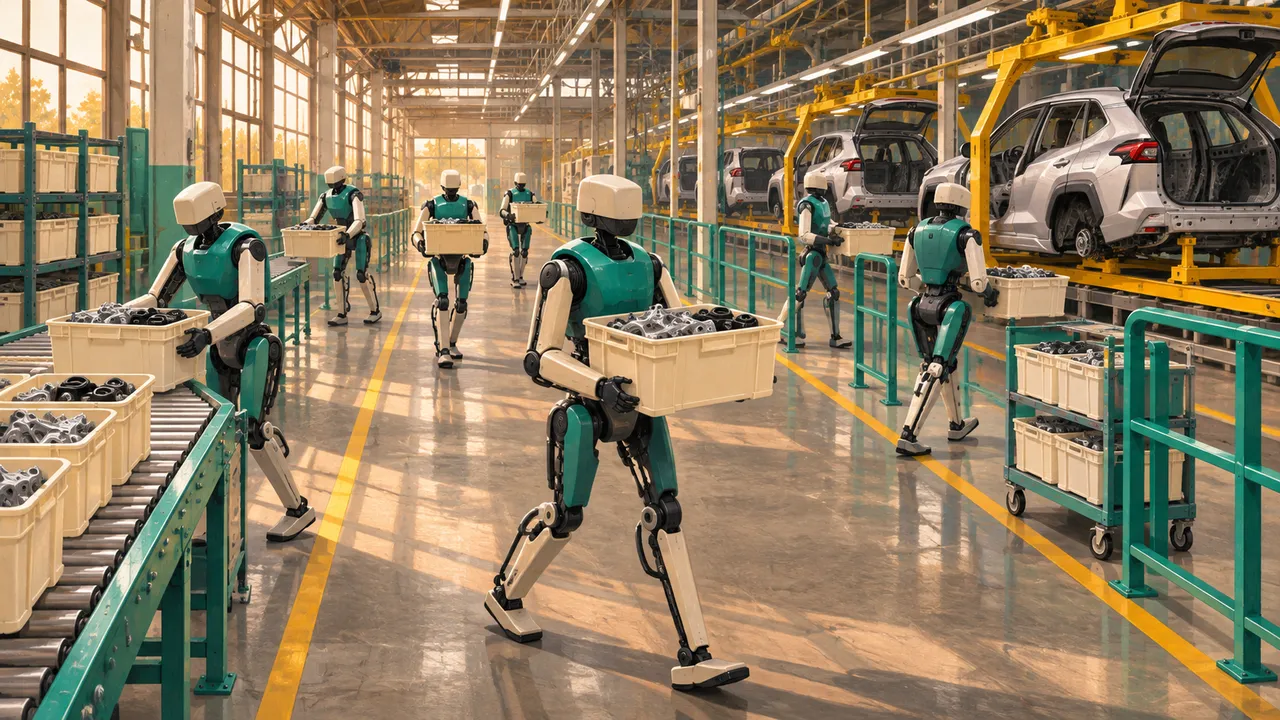
In February 2026, Toyota Motor Manufacturing Canada contracted seven Agility Robotics Digit robots under a robots-as-a-service deal, after a year-long pilot, to unload totes of auto parts in a plant building RAV4 SUVs.
On 17 February 2026 Anthropic released Claude Sonnet 4.6 at $3 and $15 per million tokens. It became the default model for Free and Pro users on claude.ai and Claude Cowork.
In February 2026 MiniMax released MiniMax-M2.5 together with M2.5-Lightning, a variant that runs at 100 tokens per second. MiniMax said the Lightning version costs $0.3 per million input tokens and $2.4 per million output tokens.
On 12 February 2026 Anthropic announced a $30 billion Series G at a $380 billion post-money valuation, led by GIC and Coatue, with run-rate revenue of $14 billion and Claude Code alone above $2.5 billion.
Apptronik reopened its Series A in February 2026, raising the round to $935 million at a reported $5.3 billion valuation, as the humanoid robot maker pushes Apollo into warehouse and industrial work.
Robert Playter announced on 10 February 2026 that he was stepping down as Boston Dynamics CEO after 30 years at the company; CFO Amanda McMaster took interim charge while a successor was sought.
On 10 February 2026 Runway announced a $315 million Series E at a $5.3 billion valuation, nearly double its previous valuation, and said the money would fund pre-training of next-generation world models.
On 5 February 2026 OpenAI released GPT-5.3-Codex for its Codex coding agent, describing it as the most capable agentic coding model to date and saying it had helped build itself. A faster research preview, GPT-5.3-Codex-Spark, followed a week later.
On 5 February 2026 Anthropic released Claude Opus 4.6, then its smartest model, with agent teams in Claude Code and a 1M-token context window in beta. Pricing stayed at $5 and $25 per million tokens.
In February 2026, Mistral AI acquired Koyeb, a Paris-based startup offering high-performance serverless infrastructure. It was Mistral's first acquisition and brought 13 employees, with Koyeb's product and expertise to support environments such as sandboxes and MCP servers.
In February 2026 OpenAI raised $110 billion at a $730 billion valuation, led by Amazon's $50 billion — at the time the largest private technology fundraise in history — a round that later closed at $122 billion.
On 29 January 2026 Alibaba's chip unit T-Head listed the Zhenwu 810E, formally revealing a PPU accelerator the company had kept under wraps and completing its combination of Qwen models, cloud and chips.
Skild AI, a maker of general-purpose robotic software, raised $1.4 billion in a Series C led by SoftBank, valuing the company at more than $14 billion.
On 12 January 2026 Apple and Google announced a multi-year collaboration in which Google's Gemini models and cloud technology would underpin Apple's next generation of foundation models, while Apple said its privacy standards would stay unchanged.
Boston Dynamics and Google DeepMind announced a partnership at CES 2026 to apply DeepMind's AI foundation models to Boston Dynamics robots, with the humanoid Atlas as the first test case.
On 16 December 2025 Databricks announced a Series L of more than $4 billion at a $134 billion valuation, up 34% from its August 2025 round, alongside a $4.8 billion revenue run-rate.
On 11 December 2025, Runway announced GWM-1, a general world model that simulates environments in real time, released in Worlds, Avatars and Robotics variants and built on the company's Gen-4.5 model.